10 Resume Mistakes That Are Quietly Costing You Every Interview
Published on July 11, 2026
Blogs
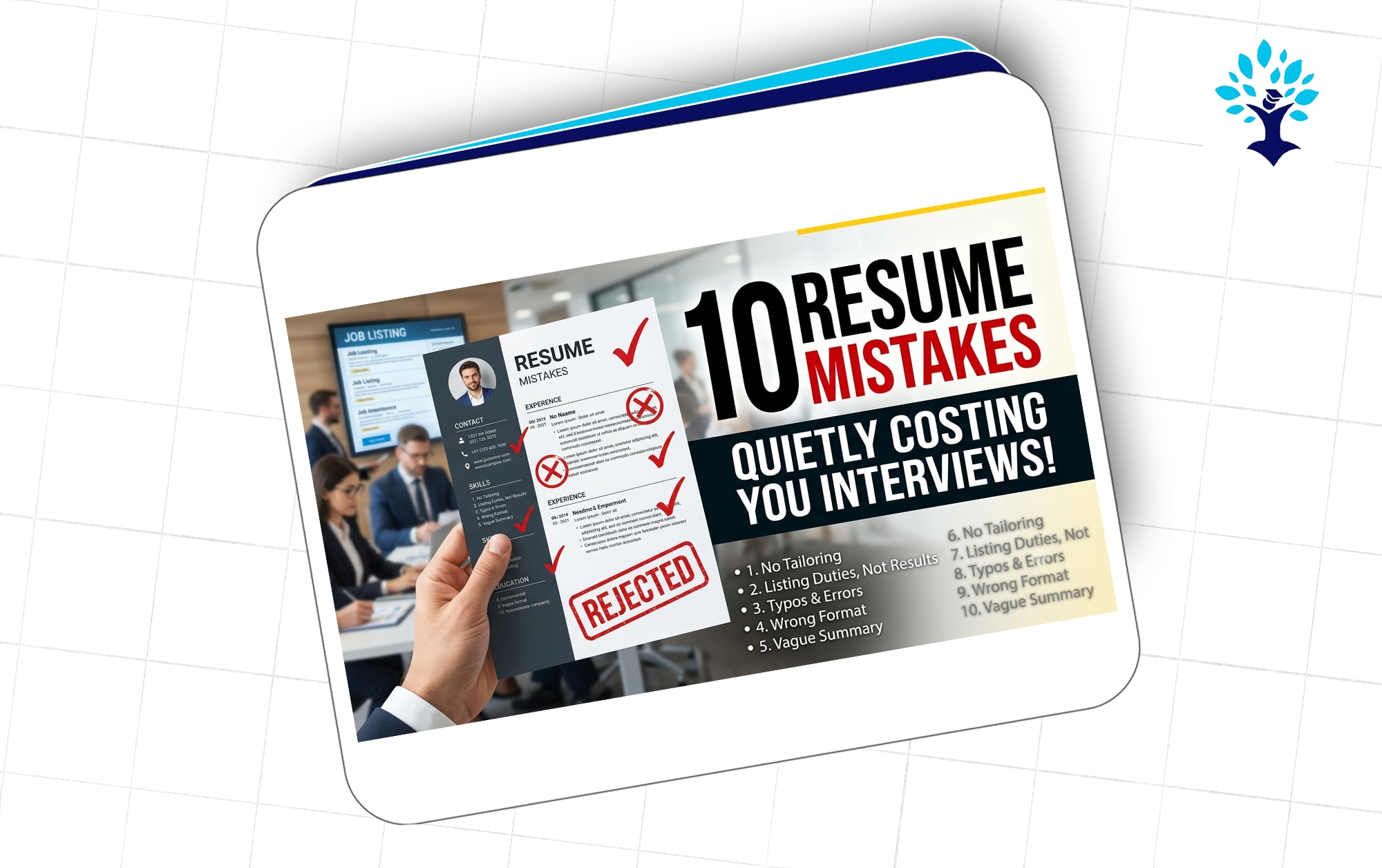
10 Resume Mistakes
You've applied to thirty jobs. Maybe more. Two replies, both rejections, neither one explaining why. Sound familiar? Here's the thing nobody tells you when you're stuck in that loop — most of the time it has nothing to do with whether you're qualified. It's something small, dumb, and completely fixable sitting right there on page one of your resume, killing your chances before a human even gets to the part where you're actually good at your job.
I've gone through hundreds of resumes that get this wrong in almost identical ways. Here are the ten mistakes doing the damage, and what to do about each one tonight, not next week.
1. You're sending the exact same resume everywhere
This is the one that hurts the most because it's the easiest to fix and almost nobody fixes it. A resume that could apply to any job at any company says nothing about why you want this job at this company. Recruiters read that vagueness in about four seconds flat. Ten minutes spent matching your summary and top bullets to the actual posting will outperform almost anything else on this list. Do this first. Do it every time.
2. Listing duties instead of actual results
"Responsible for managing social media accounts" — okay, but managed it how? What happened because you were the one doing it? Compare that to "grew Instagram following from 2,000 to 18,000 in eight months." One of these tells a hiring manager nothing. The other makes them stop scrolling.
Weak: "Handled customer complaints"
Strong: "Resolved 95% of complaints within 24 hours, lifting satisfaction scores by 30%"
If you genuinely can't attach a number, attach an outcome. Something changed because you showed up. Say what.
3. Typos. Just plain typos
It feels almost insulting to put this on a list, and yet — still happening, constantly. One typo and a hiring manager's brain quietly files you under "doesn't proofread their own work," which is a brutal thing for a single document meant to showcase your attention to detail. Read it out loud. Read it backwards if you have to. Better yet, hand it to someone else, because your own eyes are too forgiving of your own mistakes by now.
4. Falling for the pretty template trap
That two-column resume with the colored sidebar and the little skill-level bars? Looks sharp to you. To an applicant tracking system, it can read like static — sections skipped, your job titles jumbled, sometimes even your name parsed wrong. Save the design flair for a portfolio site. Your resume needs to be boring on purpose: single column, standard fonts, clear headers.
5. Burying your contact info, or using an email from 2009
Your name and contact details should be the laziest part of the page to find — top, clean, obvious. And while we're here: if you're still job-hunting from "coolguy_2009@email.com," that's quietly working against you more than you'd think. A plain firstname. Lastname address takes two minutes and removes one tiny, unnecessary reason to be taken less seriously.
6. Picking the wrong length for where you actually are in your career
One page for someone fifteen years into their career looks like you're hiding something. Three pages for someone two years out of school looks like you don't know what's actually worth including. Match it honestly:
0–5 years experience: one page
5–15 years: two pages
Senior or executive level: up to three, but only if every single line is earning its spot
7. Skipping the job description's actual language
You don't need to keyword-stuff anymore — that trick stopped working a while back. But if the posting says "client relationship management" and your resume says "customer handling," you're forcing a system (and a person) to do extra work connecting dots that should already line up. Read the posting twice before you touch your resume. Pull the real phrases. Use them naturally, not stuffed in white text like it's 2015.
8. Formatting that's all over the place
Three different date formats. Bullets that sometimes end in periods and sometimes don't. Headers in random font sizes because you copy-pasted from two old versions of the same document. None of it is fatal on its own. Stacked together, it reads as careless — and a recruiter skimming two hundred resumes a day notices careless almost instantly, even if they couldn't tell you exactly why something felt off. Pick one format. Apply it everywhere. Top to bottom, no exceptions.
9. Including personal details that have nothing to do with the job
Age, marital status, a photo, your full home address — none of it belongs on a resume anymore, and including it can genuinely work against you. It doesn't make you more relatable. It just opens the door to bias you don't even know is happening before anyone's read a single skill on your resume. Keep it tight: name, city and state, phone, email, maybe a professional profile link.
10. A summary that says absolutely nothing
"Hardworking professional seeking growth opportunities" — delete it. Right now. That sentence has been copy-pasted onto a million resumes, and it tells a hiring manager exactly zero things about you. The top of your resume is the most expensive real estate on the page. Use three lines to say what you actually do, your strongest measurable win, and what you're after next. No filler adjectives standing in for substance.
Notice what these ten actually have in common
None of them are about whether you're talented enough or experienced enough. Every single one is about care — whether you proofread, whether you tailored anything, whether you paid attention to the small stuff. A hiring manager reading your resume isn't just scanning your work history. They're reading it as a sample of how you operate when nobody's checking your work. Fix these ten things and you're not just dodging instant rejection. You're showing, in the one document a total stranger uses to judge you, that you actually take this seriously.
So go pull up your resume right now, before you close this tab and forget. Run it against this list line by line. You'll probably find two or three of these sitting there quietly, doing damage you never noticed — and every single one takes minutes, not hours, to fix.