Beat the Bot, Then Wow the Human: How to Write a Resume That Survives 2026's AI-Powered ATS
Published on July 10, 2026
How to Create a Resume
You hit submit on a job application. Somewhere in the next half second, before any human has glanced at your name, an algorithm has already decided whether you're worth seeing. That's not a scare tactic — that's just how hiring works now.
AI and applicant tracking systems have surged in recruitment, with 51% of organizations using AI for hiring in 2025 and 98% of Fortune 500 companies relying on ATS. At the largest employers, close to 80% of applicants now go through a platform with active AI ranking, while across the broader market, full AI scoring covers roughly half of all applications. Even platforms known for keeping humans in the loop have added AI layers — Greenhouse rolled out AI-assisted talent matching in early 2026, meaning some form of automated candidate prioritization now touches nearly every major hiring platform.
So no, the "one resume, send it everywhere" approach doesn't survive 2026. Here's what actually does.
First, relax about one thing: the rejection myth is mostly myth
Before you panic, know this — the viral idea that ATS auto-rejects 75% of resumes traces back to a 2012 sales pitch from a startup that shut down the following year, not any real data. Modern recruiters mostly disagree with the "instant kill switch" idea too: 92% of recruiters say these systems don't automatically reject resumes outright — the real problem is volume. ATS now convert resumes into structured data with 94 to 97% accuracy using pattern-recognition models, which means the system isn't blindly tossing you out — it's ranking you, and a badly formatted resume just ranks lower instead of vanishing outright. That distinction matters because it changes your job: you're not trying to "trick" software, you're trying to rank.
What's actually different about ATS in 2026
The keyword-stuffing trick your older cousin swears by is outdated. 2026-era ATS use semantic analysis rather than exact keyword matching, meaning they understand meaning, not just literal word overlap. Stuffing white text full of repeated keywords doesn't help anymore — it's also a good way to get your application flagged or banned from a platform entirely.
What replaced it is context. The system reads "led a five-person design team" and understands that as leadership experience, even if the job posting says "team management" instead. That's good news, honestly — it rewards people who write like humans instead of robots stuffing buzzwords into a Word doc.
The formatting rules nobody tells you until it's too late
This part hasn't changed much, and it's the part people still get wrong constantly:
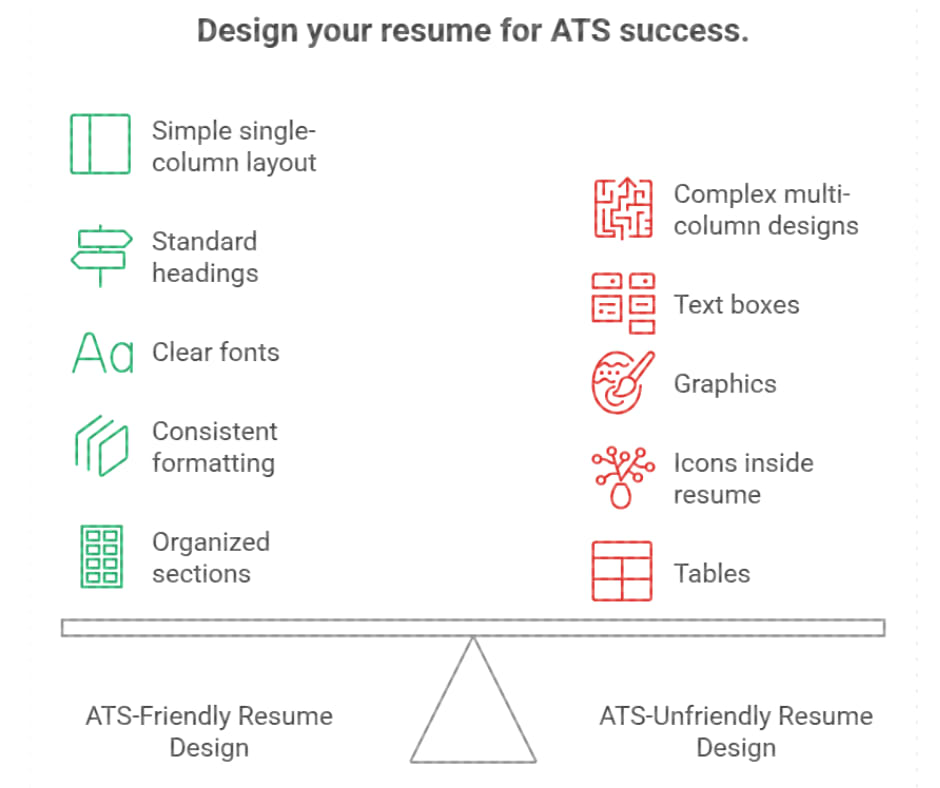
Skip tables, columns, graphics, and icons — most ATS parsers still choke on anything fancier than plain text, even in 2026
Stick to standard fonts like Calibri or Arial and conventional section headers — "Experience," "Skills," "Education," nothing creative
Save your file as a Word document or a text-based PDF, never an image-based or scanned PDF
Match your resume's job titles and skills language to the actual job posting, since keyword-rich headlines that combine job titles with core skills genuinely boost visibility
Keep it scannable — recruiters and bots both move fast, and a resume that takes thirty seconds to parse mentally has a real edge
The twist nobody saw coming: the bots have a bias problem
Here's where 2026 gets genuinely strange. Recent academic testing found AI screeners now favor AI-polished resumes at rates as high as 82% — the software prefers writing that sounds like other software. But human recruiters are moving the opposite direction: a 2026 hiring report found only 44% of managers actually trust AI screening tools, and separately, 49% of hiring managers auto-dismiss resumes they suspect were written entirely by AI.
You're being read by two judges with opposite tastes. That's not a contradiction you can argue your way out of — it's a structural fact of the 2026 job market, and ignoring it costs interviews either way.
The hybrid resume is the only thing that beats both filters
The winning move isn't picking a side. It's using AI for the layer it's genuinely good at, while keeping your actual voice intact everywhere else:
Let AI draft your professional summary and suggest keyword phrasing — this is the section AI tools are strongest at, and the section most humans write badly anyway
Rewrite the final summary yourself so it doesn't read as if it came out of a template
Replace every duty-based bullet with a results-based one — numbers, percentages, dollar figures, anything measurable
Keep your specifics unmistakably yours: project names, tools you actually used, the weird detail only someone who did the job would know
Run your resume through a free ATS-style checker before submitting, so you catch parsing errors before a real application does
That last point matters more than people think. If a free parser mangles your job titles or drops your skills section, the platform reading your actual application will do the same thing.
Why personalization is still your biggest weapon
Here's the stat that should change how you job-hunt this year: 62% of hiring managers reject AI-generated resumes specifically because they lack personalization, while 78% of managers say personalized details are the single strongest signal of genuine interest in a role.
That means the generic version of your resume — the one you've been sending to twenty companies unchanged — isn't just less effective, it's actively working against you in 2026's hiring environment. Five extra minutes customizing your summary and top three bullets to mention the actual company, the actual role, and one actual detail from the job posting will outperform a "perfect" generic resume nearly every time.
The path most people forget about entirely
Last thing, and it's easy to skip when you're deep in resume formatting: don't let the algorithm be your only door in. Referred candidates are roughly four times more likely to get hired than candidates coming through the open job board — which means while you're optimizing for the screener, you should be spending real energy on direct outreach and people who can walk your resume past the system entirely.
The resume still matters. It's just not the only lever left to pull.