Engineering Careers That Are Actually Paying Big in 2026 (And What It Takes to Land One)
Published on August 07, 2026
Blogs
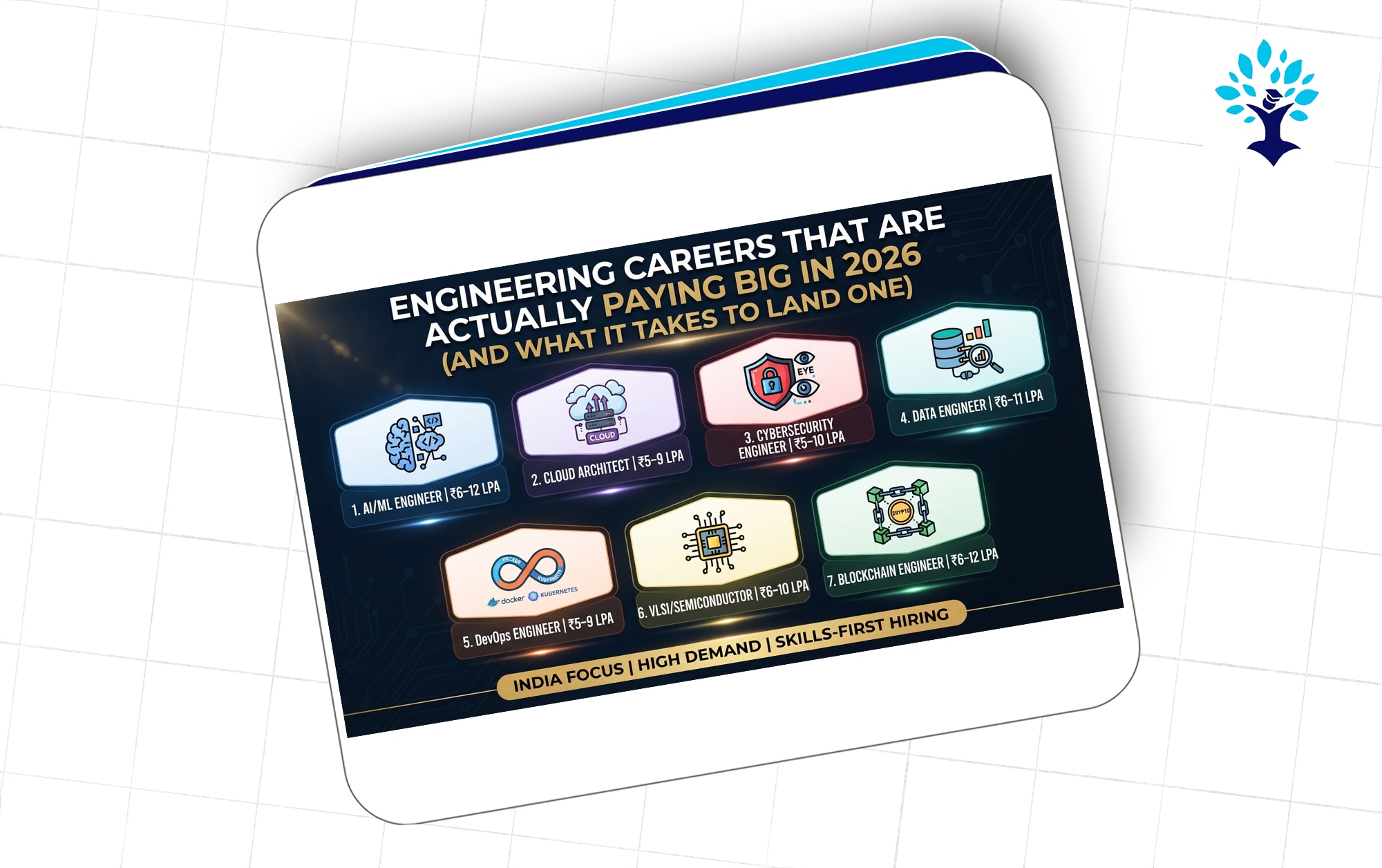
Engineering Careers That Are Actually Paying
Sit in on any final-year WhatsApp group right now, and you'll see the same question on loop: "bhai, which branch pays well this year?" Everyone has a theory. Half of it comes from a cousin who "heard something" about AI salaries, the other half from a LinkedIn post written by someone selling a course. Almost none of it holds up when you actually look at what companies are hiring for and paying for in 2026.
Here's the uncomfortable part nobody tells you at the campus placement talk: the branch name on your degree barely moves the needle anymore. What moves it is whether you can walk into a company and solve one specific, expensive problem they're stuck on. That's the whole story behind why a fresher with two solid AI projects can out-earn someone with four years of unfocused experience doing "a bit of everything." Not fair, maybe. But it's how hiring works right now, and it's worth understanding before you pick a specialization or send out your hundredth resume.
So let's get into it — where the real money is this year, and what it actually takes to get there.
Why 2026 Salaries Look So Lopsided
Companies used to hire for potential and train people on the job. That habit has thinned out a lot over the last couple of years. Budgets are tighter, teams are leaner, and every hire is expected to plug a gap on day one rather than grow into the role over six months. That's why niche, provable skills are pulling further and further ahead of generic ones — recruiters on Naukri and jobhai have been saying this for a while now, and the pattern has only sharpened heading into 2026.
There's a second thing going on, too, and it's a bit sneakier. Teams are smaller, so one person is expected to cover more ground than before. A DevOps engineer who also gets basic security. A data engineer who doesn't need a PM to explain what "conversion rate" means. Pay is climbing fastest for people who can genuinely straddle two areas instead of parking in one lane.
Right, enough context. Here's the list.
1. AI/ML Engineer
AI hasn't cooled off for a single quarter, and the pay reflects that. Fintech, healthtech, e-commerce, and even logistics firms are all hiring engineers to build recommendation systems, fraud detection, and automation that used to need entire teams.
Fresher range: ₹6–12 LPA
3–6 years experience: ₹18–35 LPA
What gets you shortlisted: solid Python, real deployment experience (not a notebook that's never left your laptop), one project you can explain start to finish without stumbling
If you want an edge over everyone else applying, get some hands-on time with LLM fine-tuning or retrieval-based systems — this specific pocket of the field has grown faster than almost anything else on this list
2. Cloud Architect / Cloud Engineer
Every company shifting infrastructure to AWS, Azure, or GCP needs people who can design something that won't fall over the first time traffic spikes. Cloud roles have turned into one of the more dependable high-paying tracks, partly because migration work never really ends — it just spawns more maintenance, scaling, and cost-cleanup work for years.
Fresher range: ₹5–9 LPA
4–7 years experience: ₹20–40 LPA
Certifications worth the effort: AWS Solutions Architect, Azure Administrator, GCP Professional Cloud Architect
Companies care less which cloud you know these days and more whether you understand cost control and basic security on top of it
3. Cybersecurity Engineer
Breaches make headlines almost every month now, and boards have finally started treating security as a line item instead of an afterthought. This is one of the rare fields where demand is outrunning the talent pool, which is exactly why the pay keeps climbing.
Fresher range: ₹5–10 LPA
5+ years experience: ₹25–45 LPA
Focus areas worth chasing: cloud security, penetration testing, compliance frameworks like ISO 27001
A candidate with a documented bug bounty or CTF result often beats one with a stack of certificates and nothing hands-on to show for it
4. Data Engineer
Data scientists get the glamour, data engineers get the paycheck for keeping the lights on underneath every dashboard and model in the building. No clean pipeline, no working AI project — it's that simple a dependency, and companies have finally started paying as they know it.
Fresher range: ₹6–11 LPA
3–6 years experience: ₹18–32 LPA
Core stack: SQL, Spark, Airflow, and at least one cloud warehouse — Snowflake, BigQuery, or Redshift
Strong SQL, if it's genuinely strong, will get you shortlisted for roles listing five other tools you haven't touched yet
5. DevOps Engineer
Deployment speed has turned into a competitive weapon, and DevOps engineers are the ones who make that speed possible without the whole thing catching fire in production. The role sits right where development meets operations, which is why it pays well for people equally comfortable on both sides.
Fresher range: ₹5–9 LPA
4–7 years experience: ₹18–35 LPA
Tools to master: Docker, Kubernetes, Jenkins, Terraform
Teams increasingly want DevOps folks who can read a basic security scan report, too, so pairing this with light security knowledge pays off fast
6. VLSI / Semiconductor Design Engineer
This one catches most students off guard, but semiconductor design has become one of the best-paying core engineering fields in India, riding on the wave of chip manufacturing investment flowing into the country over the past couple of years.
Fresher range: ₹6–10 LPA
5+ years experience: ₹22–40 LPA
Hubs to watch: Bengaluru, Hyderabad, Noida — several new fabrication and design centers are opening through 2025–2026
The learning curve bites hard early on, but stick through the first two years, and both the pay ceiling and job security tend to beat most software roles
7. Blockchain Engineer
Smallest headcount on this list by far, but the pay is disproportionate because so few engineers understand smart contracts, consensus mechanisms, and secure protocol design well enough for a company to trust them with production code.
Fresher range: ₹6–12 LPA
3–5 years experience: ₹20–38 LPA
Start with: Solidity, smart contract auditing, one Layer 1 or Layer 2 ecosystem
One warning worth taking seriously — this space is smaller and shakier than the rest, so it suits people who like the tech, not people chasing the number alone
A Quick Word on Location
Where you're willing to work changes these numbers more than most lists admit. Bengaluru and Hyderabad still top the charts for AI, cloud, and semiconductor pay, but the competition is fierce, and rent eats into that higher number faster than you'd think. Pune and Chennai have quietly become strong alternatives for data and DevOps roles — slightly lower pay, noticeably saner work hours. And smaller cities like Indore, Coimbatore, and Jaipur have seen a real jump in remote-first cloud and security hiring, with far fewer people competing for each opening. Of course, engineering isn't the only field offering strong earning potential in 2026 — finance has plenty of high-paying career options too, as our guide to Top 10 Finance Jobs with High Salaries explains.”
What Freshers Should Actually Do With This
Reading a list is easy. Getting hired off the back of it is a different fight entirely. A few things that separate the freshers who land these roles from the ones stuck refreshing their inbox for months:
Build one solid project per skill area rather than five that never got finished. A recruiter spends seconds on a resume — one deployed project with a clean write-up beats a shelf of course certificates every single time.
Pick a lane before final year, not after graduation when applications have already piled up. Resumes for AI, cloud, and security roles get filtered by keyword before a human ever looks at them.
Learn one cloud platform, no matter what your branch is. It shows up in job descriptions that have nothing obviously to do with "cloud" in the title.
Apply on portals, sure, but also go straight to company career pages. A referral or direct application moves faster than one buried in a stack of three hundred portal submissions.
Don't dismiss Tier 2 city openings because they sound less impressive on paper. Several companies have shifted hiring there purely for cost reasons, and the odds per applicant are usually much better.
Practice talking through your project out loud before the interview, not just building it. The candidate who can articulate their decisions calmly is remembered over the one who merely lists technologies like a spec sheet.
Real Talk
The name of your degree's branch matters less every passing year compared to the one problem you can prove you've solved. 2026's salaries are rewarding depth over breadth, plain and simple — one strong, demonstrable skill in AI, cloud, security, or data opens more doors than a generalist resume padded with a dozen half-known tools ever will. If you're still deciding where to specialize, go with whatever pulls you in naturally and start building something in it this month — not "after semester exams," not "once placements start." The gap between a ₹6 LPA offer and a ₹20 LPA one rarely comes down to raw talent. It comes down to how specific and provable what you know actually is, on paper, in front of someone deciding whether to call you back.