How to Crack AI-Proctored and Video Interviews: A Fresh Graduate’s Practical Guide
Published on July 25, 2026
Blogs
How to Crack AI-Proctored and Video Interviews
You've polished your resume. You've applied to 30 companies. And then — finally — an email lands in your inbox. "Congratulations! You've been shortlisted. Please complete your AI video interview within 48 hours."
And your heart sinks a little, doesn't it?
You were prepared to impress a human. Someone who would smile back, nod along, maybe cut you some slack. Instead, you're staring at a camera, talking to an algorithm.
Here's the truth nobody tells fresh graduates: AI video interviews are now the gatekeepers of the hiring world. They can screen 100+ candidates down to just 2 or 3 before a single human recruiter ever looks at your profile. If you don't clear this round, your dream company will never actually meet you.
But here's the good news — once you understand how they work, these interviews become very, very clear. This guide will walk you through everything.
First, What Exactly Is an AI Video Interview?
An AI video interview is a digital interview where you respond to questions either through recorded videos or in a live online session. Your answers are reviewed using AI technology before or alongside a human recruiter.
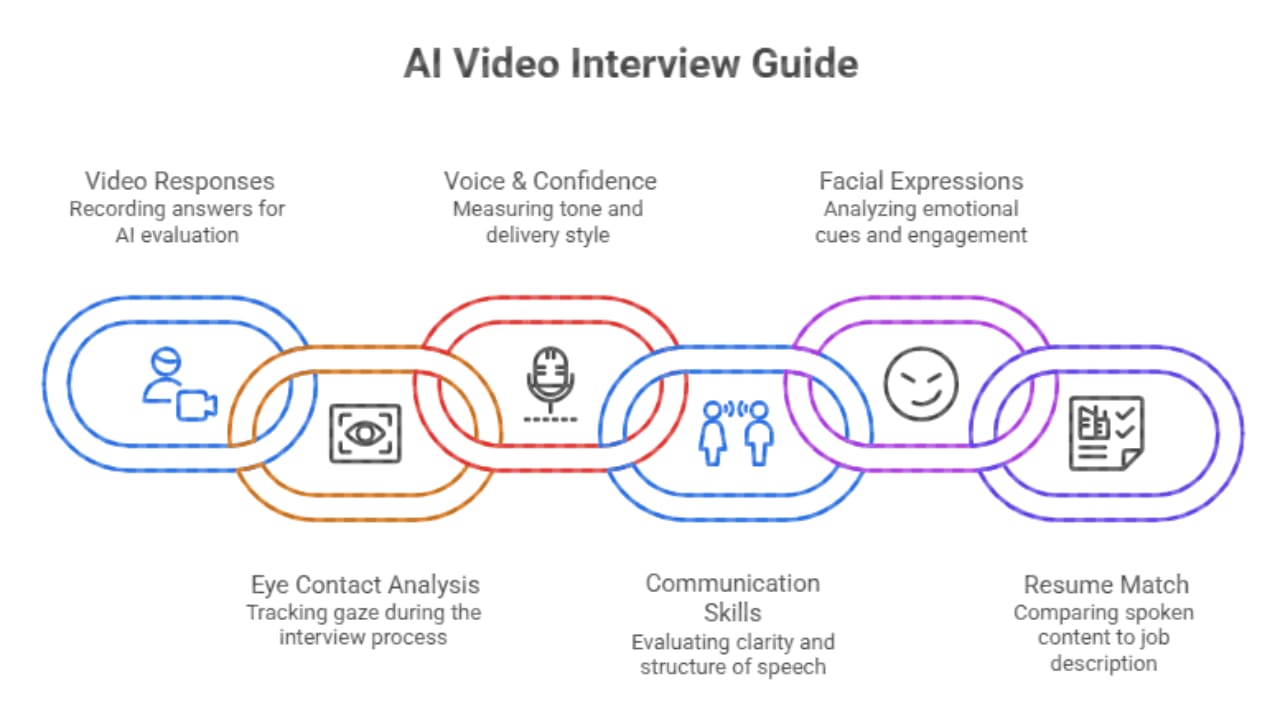
What many candidates don't realize is that the evaluation goes beyond the words they speak. The system may also consider how consistently and confidently those responses are delivered. These platforms analyze:
Your eye contact and facial expressions
Your voice tone, pace, and confidence
The structure and clarity of your answers
Your communication fluency — how naturally you express yourself
Your energy and engagement throughout the session
In some cases, even your resume vs. the job description — checking for keyword alignment
AI-based hiring has quietly become a standard part of recruitment. Whether you're applying for a graduate role or an internship, there's a good chance you'll come across platforms like HireVue, Vervoe, Spark Hire, Karat, or Mettl for interviews and online assessments. Many employers also use AI proctoring during aptitude or coding tests to keep track of screen activity, eye movement, and the overall test environment.
That's why the interview effectively begins the second you press "Start Interview." The way you sit, respond, pause, or interact with the screen can all contribute to the overall assessment, long before you've finished answering the first question.
Why Do Fresh Graduates Struggle Here?
Let's be honest about this.
Most of us come from an education system where we're tested on what we know — facts, formulas, definitions. But AI interviews test how you communicate what you know.
Fresh graduates often struggle because:
They've never practiced speaking on camera before
They give answers that are either too vague or too textbook-perfect
They get nervous and freeze, rush, or ramble
They don't realize their environment, background, and body language are being evaluated too
They try to sound impressive instead of sounding real
The fix? Awareness and practice. That's it. Let's break it down step by step.
The Most Common Reasons Candidates Get Rejected
Before we talk about what to do, let's talk about what costs people their shot:
During the interview itself:
Reading answers off another screen or using notes too obviously
Poor or inconsistent eye contact with the camera
Flat, monotone voice with no energy or variation
Giving vague, generic answers like "I'm a fast learner and a team player"
Answers that are too short (30 seconds) or too long (5+ minutes)
Memorized-sounding responses that feel robotic and rehearsed
Freezing up with long, awkward silences
Not following the platform's specific instructions
Before the interview even starts:
Resume language that doesn't align with the job description
Background noise, poor lighting, or a messy environment
Technical glitches from not testing your setup in advance
Wearing casual clothes because "it's just a video"
Any one of these can quietly get you filtered out.
Step 1 — Understand the Three Types of Questions You'll Face
AI interviews typically test you across three areas. Walk in knowing which category a question belongs to, and you'll structure your answer far better.
1. Behavioral Questions
These are the classic "Tell me about a time when..." questions. They want to understand how you've acted in real situations.
Examples:
"Tell me about a time you faced a challenge and how you handled it."
"Describe a situation where you had to work in a team under pressure."
"Give an example of a time you made a mistake and what you learned."
Even as a fresh graduate with limited work experience, you can draw from college projects, internships, volunteering, leadership roles in student clubs, or even personal challenges you've overcome.
2. Situational / Scenario-Based Questions
These are "What would you do if..." questions. They test your thinking process and judgment.
Examples:
"If a client is unhappy with a deliverable, how would you handle it?"
"You're given three urgent tasks with the same deadline. What do you do?"
"How would you approach learning a new skill your role requires?"
There's no single right answer here. They want to see your logic, composure, and practical thinking.
3. Technical / Role-Specific Questions
These vary by job. For a marketing role, you might be asked about campaign metrics. For a data role, about SQL or analytical thinking. For a sales role, about objection handling.
Always revisit the job description before your interview. The questions often mirror exactly what's mentioned in the requirements.
Step 2 — Fix Your Setup Before You Say a Single Word
This is underrated by almost every fresh graduate.
Your environment is part of your first impression — and in an AI interview, it's evaluated too.
Here's your pre-interview checklist:
Sit in a quiet room with no background noise
Make sure the room is well-lit — ideally with light facing you, not behind you
Keep your background clean and distraction-free (a plain wall works perfectly)
Position your camera at eye level — not looking up at you, not looking down
Wear professional clothes, at least on top — it shifts your own mindset too
Use a stable internet connection — mobile data as backup if needed
Test your camera, microphone, and speakers at least one hour before
Close all unnecessary tabs and silence your phone completely
One technical glitch can cost you more than a weak answer. Don't let it.
Step 3 — Structure Every Answer (Even Under Pressure)
This is the single biggest differentiator between candidates who get shortlisted and those who don't.
When a question appears, don't start talking immediately. Take 5–10 seconds to organize your thoughts. Then follow this simple structure:
What I did → How I did it → What happened / What I learned
This is a simplified version of the STAR method (Situation, Task, Action, Result) — and it works for almost every type of question. One of the first questions in many AI video interviews is Tell me About Yourself, so having a structured introduction ready can help you start the interview with confidence before moving on to role-specific questions.
Example: Question: "Tell me about a time you had to manage a tight deadline."
Weak answer: "I always try to manage my time well. I make lists and prioritize things. I think I handle pressure pretty well."
Strong answer: "During my final year, my team had a product prototype due in 48 hours. We were three people and had fallen behind. I took charge of breaking the project into tasks, assigning them based on each person's strength, and we worked in shifts. We submitted on time, and our professor highlighted it as one of the best-organized submissions. It taught me that clarity of roles removes panic in a team."
See the difference? Specifics. Action. Outcome. That's what structured answers look like.
Step 4 — How to Speak Naturally on Camera
This is where most people feel awkward, and honestly, that's normal. Speaking to a camera feels unnatural at first. Here's how to make it feel less so.
Look into the camera, not at your own face on screen. Looking at yourself is the #1 mistake. The camera lens is your "eye contact."
Speak like you're explaining something to a friend who's smart but not an expert in your field. Avoid jargon for jargon's sake. Clarity is more impressive than complexity.
Vary your tone. If you speak at the same pitch and pace for 3 minutes, the AI — and any human reviewer — will tune out. Let your voice rise slightly when you're excited about something. Slow down when you're making a key point.
Don't perform. Trying too hard to seem confident often reads as nervousness. Being genuinely engaged with the question is what reads as confidence.
Pause with purpose. A 2-second pause before your answer looks like you're thinking. A 10-second silence looks like you're panicking. Practice timing your pauses.
Step 5 — What To Do When You Don't Know the Answer
Here's something they don't teach in college: admitting you don't know something — the right way — can actually impress an interviewer.
Don't bluff. AI platforms that analyze response patterns can detect inconsistency. Human reviewers definitely can.
Instead, say something like:
"I don't have direct experience with this yet, but here's how I would approach learning it..."
"I have foundational knowledge in this area. In practice, I would [explain your thinking]."
"That's an area I'm actively building skills in. Based on what I know so far..."
Honesty, paired with the willingness to learn, is exactly what companies hiring fresh graduates are looking for. You're not expected to know everything — you're expected to be coachable.
Step 6 — How AI-Proctored Assessments Are Different
If you're taking a written test, coding assessment, or aptitude test online, you may be in an AI-proctored environment — where a tool monitors you for the duration of the test.
Here's what proctoring software typically tracks:
Eye movement — if you look away from the screen frequently, it flags it
Multiple faces in the camera frame
Tab switching or opening other applications
Background audio — voices, TV, phone calls
Mouse movement patterns that suggest copy-pasting
What this means for you practically:
Don't look away from your screen repeatedly, even to think
Take the test in a private, quiet room
Close every other application and browser tab
Don't use your phone during the test
Read all instructions before starting — you often can't pause
If a technical issue occurs, screenshot it and report it immediately
Being flagged as a suspicious candidate — even incorrectly — can disqualify you automatically.
Step 7 — Align Your Resume Before Every AI Interview
This is one thing most candidates completely skip, and it's a huge mistake.
Many AI hiring platforms cross-check your resume against the job description before you even hit record. If there's a significant mismatch in keywords, skills, or experience language, your profile may be deprioritized before the interview score even matters.
Before every AI interview:
Re-read the job description carefully
Note the key skills, tools, and responsibilities mentioned
Make sure your resume reflects those keywords where they genuinely apply
In your answers, use the same language the company uses in their JD
This isn't about gaming the system. It's about speaking the same language as the role you're applying for.
How to Practice (Without Feeling Stupid)
The truth: you will feel awkward practicing on camera. Do it anyway.
Practical ways to practice:
Use free AI mock interview tools like Interview Warmup by Google, Yoodli, or HireVue's practice feature
Record yourself on your phone answering common interview questions — then watch it back (yes, it's uncomfortable, yes, it works)
Practice with a friend over a video call and ask for specific feedback on structure and energy
Write down 5–7 key experiences from college or internships that you can adapt to different question types
Time your answers — aim for 90 seconds to 3 minutes per answer, depending on the question type
The goal of practice isn't to memorize answers. It's to get comfortable enough that your brain doesn't go blank the moment the record button lights up.
Quick Reference: Do's and Don'ts
For AI-proctored and video interviews, a few simple habits can significantly improve your performance. Look directly into the camera instead of at your own video feed, as it creates better eye contact and shows confidence. Structure your answers with a clear beginning, middle, and end instead of rambling without a purpose. Before the interview, test your internet connection, microphone, camera, and lighting so you don't face avoidable technical issues.
Even though the interview is online, wear professional attire to make a positive impression. If you're asked about a skill you don't have, be honest and explain how you're learning rather than bluffing or giving fake-confident answers. Also, tailor your resume to match the job description instead of submitting the same generic version everywhere. Finally, practice answering questions on camera before the real interview to become comfortable with your body language and speaking style. When a question is asked, take a brief pause to gather your thoughts before responding. This helps you give a more organized answer and avoids both rushing and long, awkward silences.
Final Thought — From One Person Who Figured This Out the Hard Way
AI interviews can feel cold, impersonal, and a little intimidating. But remember — they're not designed to trip you up. They're designed to find candidates who are clear, genuine, and able to communicate who they are.
You don't need to be perfect. You need to be prepared, structured, and real.
The companies you want to work for are not looking for someone who recites textbook answers flawlessly. They're looking for someone who thinks clearly, communicates honestly, and shows up with energy and intention — even on camera, even in a room alone, even when nobody's smiling back.
That person can absolutely be you.
Now go practice. Your offer email is closer than you think.