The "No Experience" Excuse Doesn't Work Anymore — Here's What to Build Instead
Published on August 13, 2026
Blogs
The "No Experience" Excuse Doesn't Work Anymore
"Minimum 1-2 years experience required" shows up on nearly every decent job posting, and it's the single biggest reason freshers give up before even applying. Here's what most people miss though — that line filters out lazy applicants, not resourceful ones. A portfolio built entirely on your own, with zero formal work history behind it, can carry more weight in an interview than a mediocre internship ever would, provided it's built the right way.
This isn't about faking experience or padding a resume with vague claims. It's about creating real, checkable proof of skill when nobody's handed you a job to prove it through yet. Every field discussed below has candidates who've done exactly this and gotten hired because of it.
Why a Portfolio Beats "Experience" More Often Than You'd Think
A recruiter reading "1 year experience" on a resume has no idea what that year actually involved. Maybe it was genuinely hands-on work. Maybe it was mostly attending meetings and updating spreadsheets nobody looked at twice. Experience, as a line on paper, is vague by default.
A portfolio isn't vague. It's a direct, checkable answer to "can you actually do this?" That's exactly why hiring managers across marketing, design, writing, and even entry-level tech roles have started weighing a strong portfolio over a thin, unremarkable work history. It removes the guesswork — they can look at what you built, judge it themselves, and skip the leap of faith a bare resume forces them to take.
What Actually Counts as Portfolio Work
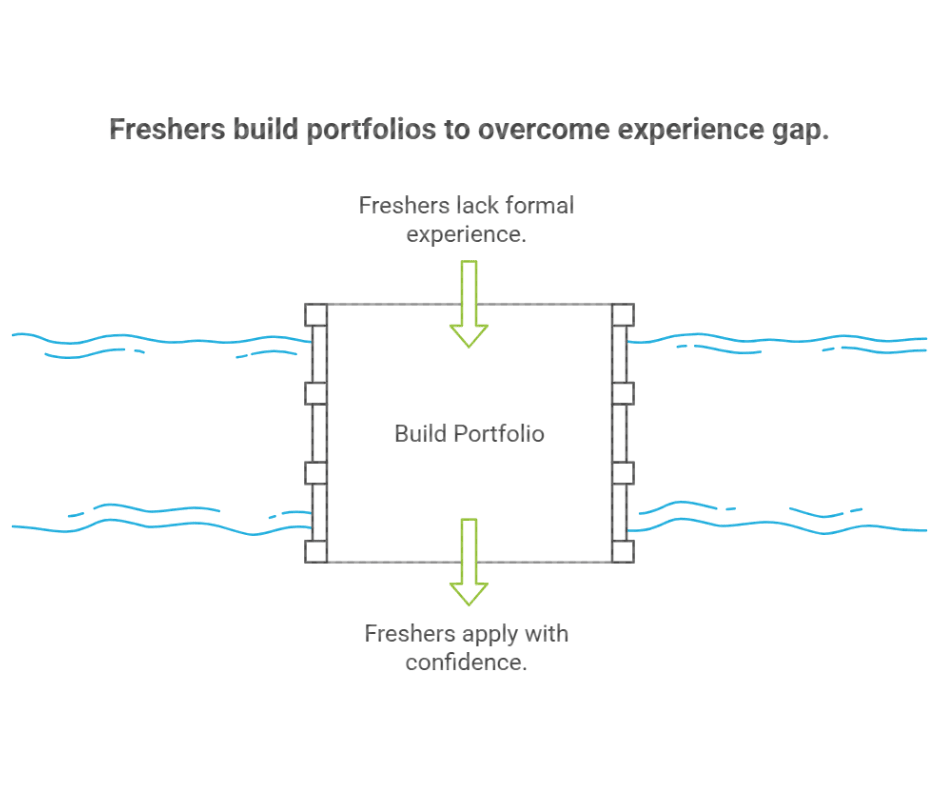
A lot of freshers assume portfolio work has to come from a "real" client or company, and that assumption alone stops most people before they even start. It doesn't.
Self-initiated projects count, and often count more than people expect — redesigning an app you personally find frustrating, writing and publishing articles on a topic you know well, building a small tool that solves a problem you actually have. Volunteer or unpaid work for a local business, a college club, or a family friend's shop counts too, and it's frequently easier to land than people assume, since small businesses rarely say no to free help. Even coursework, if reframed properly, can count — a college project redone with more polish and a clear write-up of your thinking looks entirely different from a project buried in an old submission folder.
What doesn't count is a half-finished tutorial project copied step by step with nothing changed. Recruiters can tell the difference within seconds, and a portfolio full of these does more harm than having no portfolio at all.
Building a Portfolio for Marketing and Content Roles
Marketing is one of the friendliest fields for building a portfolio from scratch, mainly because the tools to do real work are free and the work itself is publicly visible by nature.
Run a small ad campaign for a friend's shop, a college event, or even a personal project, and document the results honestly, including what didn't work
Start a blog or LinkedIn presence around a topic you genuinely know, and grow it consistently for a few months instead of posting sporadically
Offer to manage social media for a local business or NGO for free in exchange for permission to use the work as a case study
Track and present real numbers wherever possible — engagement growth, click-through rates, follower increases — since numbers convince far more than a polished-looking post ever will on its own
Building a Portfolio for Design and UX Roles
Design portfolios live or die on process, not just final visuals, and that's exactly where most beginner portfolios go wrong.
Redesign something broken instead of designing from a blank page — pick an app or website you use regularly and find genuinely frustrating, then rework it with a clear explanation of what problem you were solving and why you made each decision. This matters more than people realize, because a case study explaining your thinking beats a pretty final screen with no reasoning attached, every single time an interviewer actually reviews it.
Build two or three deep case studies rather than ten shallow ones
Include the messy middle — sketches, wireframes, early drafts — not just the polished final output
Get feedback from a design community online and show at least one project you genuinely revised based on that feedback
Host the portfolio somewhere clean and easy to browse, since a cluttered or confusing portfolio site undermines the exact skill you're trying to demonstrate
Building a Portfolio for Tech and Data Roles
For coding, data, and analytics roles, GitHub effectively becomes the portfolio, and how you use it matters as much as what you build.
Work with real, messy datasets instead of the clean, pre-processed ones most beginner tutorials hand you — Kaggle and various government open data portals in India offer plenty of raw material that actually resembles the kind of data you'd deal with on a real job. Document each project with a clear README explaining the problem, your approach, and what you learned, since an undocumented pile of code communicates far less than a well-explained smaller project does. Two or three genuinely finished, well-documented projects consistently beat ten abandoned repositories with nothing but a single commit each.
Common Mistakes That Quietly Weaken a Fresh Portfolio
A few patterns recur in portfolios that don't land interviews, and most are easy to fix once you notice them.
Too much quantity, too little depth is probably the most common one — ten shallow, unfinished projects say less than two or three that are genuinely complete and well explained. Copying tutorials without adding a personal problem or angle is another, since it demonstrates that you can follow instructions but not think independently. And skipping the explanation entirely — presenting only the final output without any context on your process or decisions — leaves a recruiter guessing at exactly the thing a portfolio is supposed to prove.
Talking About This Portfolio in an Interview
Building the work is only half the job — plenty of strong portfolios still fall flat because the person behind them can't talk through it confidently. When an interviewer asks about a self-initiated project, resist the urge to undersell it with a nervous "it was just something I did for fun." Walk through it the same way you would a real client project — what the problem was, what you tried, what didn't work the first time, and what you'd do differently now. That last part matters more than people expect, since admitting a project's weak points and explaining what you'd change shows a level of self-awareness that a flawless-sounding story never quite manages to convey.
Final Thought
"No experience" stopped being a real barrier the moment self-initiated, well-documented work became this easy to build and this visible to recruiters. Pick two or three projects in your target field, finish them properly, explain your thinking clearly, and let that speak louder than a blank "experience" section ever could. And if you're still deciding which career path to build that portfolio for, explore these High-Paying Careers for Non-Engineers in India before choosing your direction. The candidates getting hired without formal experience aren't the lucky ones — they're the ones who stopped waiting for someone to hand them a chance to prove themselves.