Top 5 Tech Careers Worth Betting On in 2026: AI, Cyber, Cloud, Data, and What Comes After
Published on August 05, 2026
Blogs
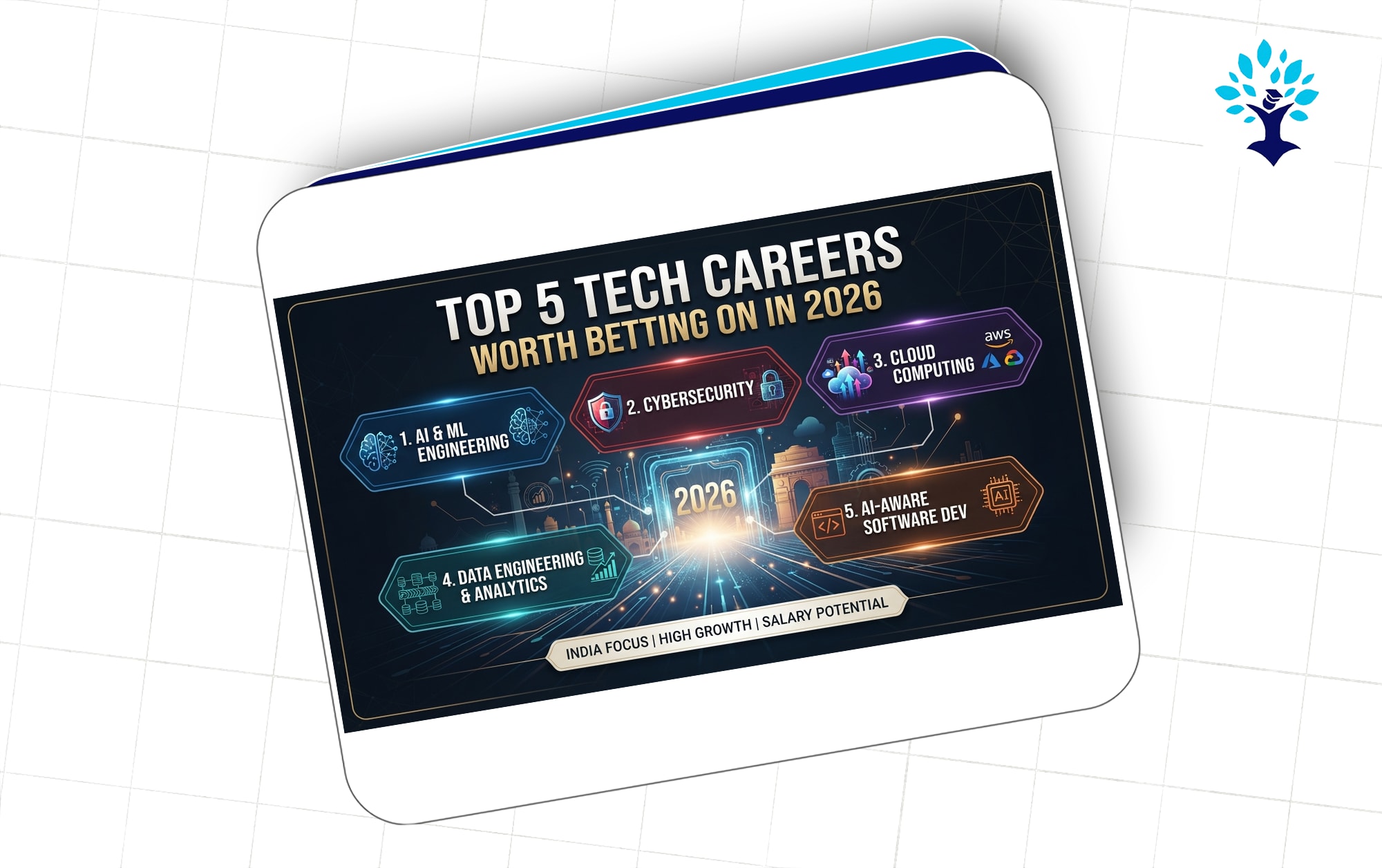
AI, Cyber, Cloud, Data, and What Comes After
A few years back, most people figured software development would just keep being the safe tech bet forever. Learn to code, land a dev job, ride it out for a couple of decades, done. Then AI showed up everywhere at once. Cloud computing exploded past anyone's predictions. Cybersecurity turned from an IT afterthought into a boardroom priority almost overnight. The ground shifted fast, and it hasn't really slowed down.
So if you're picking a tech path in 2026, or thinking about switching into one from something else entirely, five areas keep showing up at the top of every hiring report, every salary survey, every NASSCOM projection worth your time. Not a random top-five list either. These are the roles companies are visibly struggling to fill, in India and everywhere else, and the pay reflects exactly how badly they need people for them.
AI and Machine Learning Engineering
This one sits at the top, and it's not close. India's AI market is projected to reach close to $29 billion by 2025, growing at a 45 percent yearly clip, and the government put its money where its mouth is with a ₹2,000 crore allocation for AI infrastructure in the last Union Budget. Every big name you can think of, TCS, Infosys, Wipro, Amazon India, has an active AI hiring drive running right now, not sometime next year.
Quick thing worth clearing up first: AI and ML engineering isn't the same as data science, even though people mix the two up constantly, sometimes even in the job postings themselves. A data scientist analyzes and interprets patterns buried in data. An AI or ML engineer builds and ships the production system running on top of those patterns. Recruiters have stopped treating these as interchangeable, so knowing the difference matters the moment you sit down to write a resume.
Freshers typically start around ₹7 to ₹12 LPA, and experienced ML engineers hit ₹25 to ₹60 LPA at the top companies
Core entry requirement: Python, ML fundamentals, and a real project you built with your own hands, not just a stack of certificates
India is now the second-largest AI talent hub globally after the US, with demand climbing roughly 45 percent year on year
The gap between demand and supply here is still wide open, which is exactly why the pay keeps climbing every single year
Cybersecurity
Cybercrime caused an estimated $10.5 trillion in damage worldwide in 2025 alone. Sit with that number for a second. That's basically why every company with a digital footprint, which by now is every company, is scrambling to hire for this. Information security analyst roles are projected to grow 29 percent by 2034 in the US, and India's own cybersecurity hiring need is already past 1 million jobs, according to NASSCOM.
What's shifted lately is the scope of the role itself. Demand for AI governance skills rose 150 percent over the last year, AI ethics skills close behind at 125 percent, which tells you cybersecurity is expanding well past stopping hackers into governance, risk, and compliance territory, too. It's not just "keep the bad guys out" anymore. It's making sure the AI systems themselves don't turn into the next big vulnerability without anyone noticing.
Salaries in India generally range from ₹5 to ₹22 LPA, depending on specialization and how senior you are
Core skills needed: network security, ethical hacking, threat analysis, cloud security, and increasingly, working alongside AI-enabled security tools
One of the few tech fields with both a high growth rate and a strong pay floor even at entry level, which makes it a fairly safe bet if you're just starting out
Cloud Computing
Almost every mid-to-large company has moved its operations onto AWS, Azure, or Google Cloud by now, and that migration created a huge, ongoing need for people who can build, secure, and manage all of it day to day. Cloud architects and engineers are in demand across IT, fintech, and SaaS alike, and that shortage doesn't look like it's closing anytime soon.
Indian salaries typically fall between ₹6 and ₹20 LPA, with senior cloud architects earning well above that ceiling once they've got a few years in. Certifications matter more here than in most tech fields, probably more than they should, if we're being fair about it. AWS, Azure, and GCP credentials carry real weight with recruiters, sometimes more than a degree does at the interview stage. And DevOps skills increasingly overlap with cloud work these days, so learning both together builds a stronger profile than picking just one and stopping there.
Data Engineering and Data Analytics
Every AI system, every dashboard, every business decision built on data needs someone maintaining the pipeline underneath it, mostly in the background, usually without much credit. Data engineers design and manage the large-scale systems that make all of it possible, and they're consistently underrated next to flashier AI roles, even though the pay tells a pretty different story once you look closely.
Big data engineers in India earn between ₹4 and ₹34 LPA, with US salaries running $110,000 to $160,000
Data analytics roles specifically land around ₹4 to ₹15 LPA for entry-to-mid-level work, and don't always need a full computer science background to break into them
SQL, Python, and at least one cloud data platform cover most of what gets asked in interviews for this right now
This field rewards people who like structure and process, not necessarily people chasing the flashiest job title in the room
Software Development, Reframed for 2026
Traditional software development hasn't disappeared. It's just turned into something a bit different from what it was five years back. The developers pulling the strongest salaries today are the ones who've folded AI tooling, cloud-native development, and basic security awareness into their core skillset instead of sticking to plain full-stack work alone.
Full-stack development in India runs roughly ₹5 to ₹18 LPA, with AI-integrated roles pushing past that. DevOps engineering, sitting right at the intersection of dev and cloud, ranges from ₹7 to ₹22 LPA. The developers pulling ahead aren't necessarily the smartest ones in the room, either. They're the ones who treated AI and cloud as core skills early, not optional extras bolted on later once everyone else already had them figured out.
How Freshers Really Break Into These Fields
Getting into any one of these five doesn't need a perfect resume or a big-name college attached to it, and that's a real shift from how tech hiring worked even a decade ago. What moves the needle instead:
Build two or three real, working projects in your chosen area rather than collecting a shelf of half-finished course certificates
Pick one platform and go deep instead of dabbling across five. A solid AWS project beats a shallow familiarity with three different cloud providers
Contribute to something open-source, even something small. It shows initiative in a way a resume bullet never quite manages. A strong personal profile matters too, because recruiters don't just evaluate what you can do — they also form judgments based on the credibility and reputation surrounding what you present. This is one reason understanding [Why people trust big brands] can be useful when thinking about how employers perceive credentials, companies, and professional signals.
Learn to explain your projects clearly out loud. Plenty of technically strong candidates lose out because they can't walk someone through what they built in plain language
Don't wait for a "complete" skillset before applying. Most hiring managers care more about direction and momentum than a finished checklist anyway
What Ties All Five Together
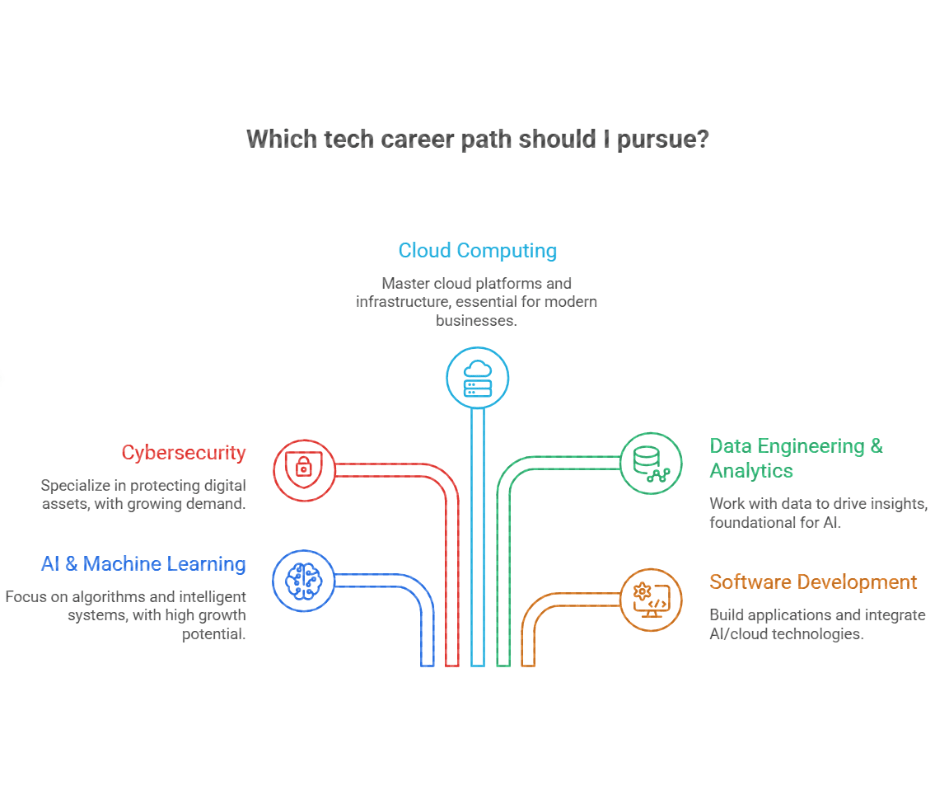
None of these fields exists in isolation anymore, not really. A cloud engineer who understands basic security is worth more than one who doesn't. A data engineer with AI pipeline experience clears interviews faster than one without it. Companies aren't hiring for narrow, siloed skillsets the way they did a decade ago, back when a developer could get away with knowing exactly one stack and nothing else. They want people who move across two or three of these areas comfortably, and that cross-skilling is quickly becoming the real differentiator on a resume, more than any single certificate ever could be on its own.
Sixty-five percent of Indian tech companies now prioritize demonstrated, project-based skills over formal degrees alone, according to NASSCOM's own data. That's real news if you're building a career from scratch or switching in from something completely unrelated. A structured course, a handful of real projects, and a clean skills assessment can outperform a degree with no practical work behind it.
A Quick Word on Picking Wrong
Nobody gets this decision perfectly right the first time, and that's fine. Someone who starts in cybersecurity and realizes two years in that cloud infrastructure excites them more hasn't wasted anything at all. The underlying skills, problem-solving, working with systems at scale, reading documentation without panicking, carry over across these five fields far more easily than people expect walking in. The real risk isn't picking the "wrong" one of these five. It's picking none of them and staying stuck somewhere that isn't growing at all.
Final Thought
Five years from now, this exact list might look a little different. Something new will show up on it, something else will mature and pay less of a premium than it does today. That's just how tech works, always has been. But right now, in 2026, AI, cybersecurity, cloud, data, and AI-aware software development are where the real hiring pressure and real salary growth are happening, both in India and everywhere else. Pick one to go deep in first. Build outward into a second once you've got real footing under you. Depth first, breadth second, that's the combination that gets noticed by whoever's doing the hiring.