Virtual Interview 2026: The Complete Prep Guide Nobody Gave You Before Your Last Video Call
Published on July 30, 2026
Blogs
The Complete Prep Guide Nobody Gave You Before Your Last Video Call
Video interviews stopped being a "backup plan" a while ago. In 2026, they're often the first — and sometimes only — round standing between your resume and a job offer. And here's the part most job seekers still get wrong: they prepare for a virtual interview the same way they'd prepare for an in-person one, then wonder why the offer went to someone else.
A screen changes the rules. Your body language reads differently. Your voice carries more weight because there's less else to judge you on. And in a growing number of cases, the person "interviewing" you isn't a person at all — it's an AI system scoring your responses before a human ever sees your application. If you're job hunting in India right now, chances are you've already run into at least one of these formats, whether it was a live Google Meet round or a recorded one-way video screening. This guide walks you through exactly how to prepare, what's changed this year, and the small details that quietly decide whether you move forward or get filtered out.
Why Virtual Interviews in 2026 Are a Different Game
The hiring funnel has gotten narrower and faster at the same time. Companies are screening larger applicant pools using video and AI tools before a recruiter ever picks up the phone. Some of what's now common:
AI-assisted video screenings where a bot asks preset questions and you record answers within a time limit, sometimes with just one retake allowed
Async one-way interviews that you complete on your own schedule, often within 24-48 hours of being invited
Live panel interviews over video are still very common for mid-to-senior roles, but are now frequently mixed with a recorded round earlier in the process
AI scoring of tone, clarity, and word choice, not just what you say but how you say itNone of this means the game is unfair. It means preparation now has to cover things that never mattered in a face-to-face interview — your camera angle, your lighting, how you sound when no interviewer is nodding along to reassure you.
Before the Interview: What to Actually Do
Most candidates spend their prep time only on answers. That's necessary but not sufficient. Here's what separates a smooth interview from a stressful one.
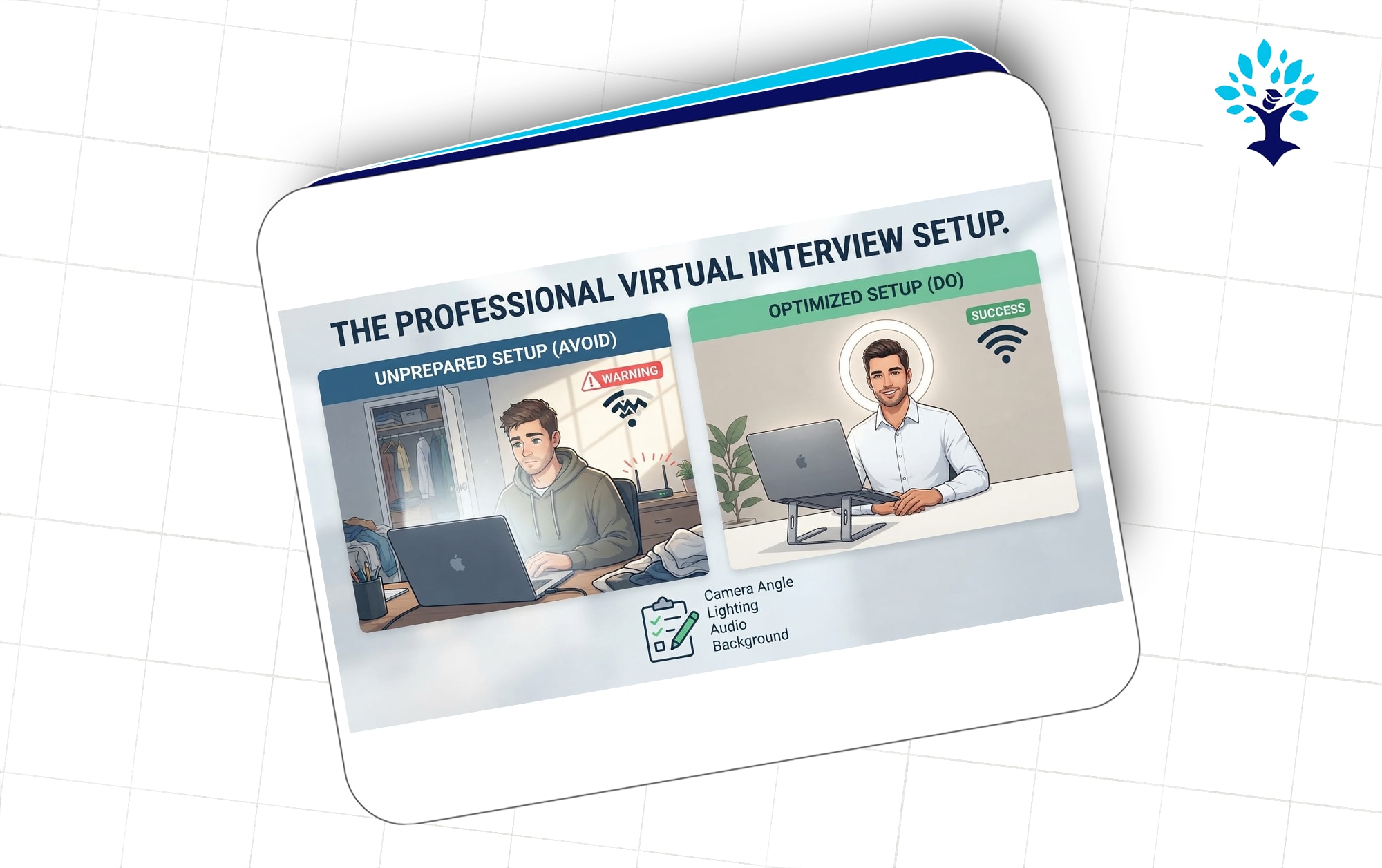
Test your setup a day in advance, not five minutes before. Check your internet speed, camera angle (eye level, not looking down at you), and audio quality. A cracking mic can cost you more than a weak answer.
Choose your background deliberately. A plain wall or tidy corner works better than a cluttered room. If you're using a virtual background, make sure it doesn't glitch around your face.
Research beyond the job description. Look up how the company actually operates — remote-first, hybrid, project-based teams — and be ready to connect your answers to that context. Recruiters notice when a candidate has clearly done this.
Prepare answers using the STAR method (Situation, Task, Action, Result). This structure works especially well on video because it keeps your answers tight and easy to follow when there's no natural back-and-forth to fill gaps.
Practice speaking to a camera, not a person. This feels unnatural at first. Record yourself answering three or four common questions and watch it back — you'll immediately spot habits like looking away, rushing, or trailing off.
Keep a notes sheet just out of camera view. Bullet points on your achievements, questions to ask, and key company facts are fair game in a virtual setting — just don't read them word for word.
If You're Facing an AI or Recorded Interview Round
This format trips up even strong candidates simply because it feels alien. A few things genuinely help:
Speak at a measured pace and look directly into the camera lens, not the screen — it simulates eye contact far better than you'd expect
Treat the timer as a structure, not a threat. Most systems give you 60-90 seconds per question; use the first few seconds to mentally frame your STAR answer before speaking
Don't over-rely on retakes if the platform allows one. Your first attempt is usually closer to how you'd perform live, and over-polished retakes can sound rehearsed
Avoid stuffing answers with buzzwords hoping to game a keyword-scoring system — most tools evaluate coherence and relevance, not just vocabulary
If the platform allows you to ask about how AI is used in the process, it's a completely reasonable question to raise later in a human round
During the Interview: Small Things That Carry Weight
Sit slightly back from the camera so your upper body and hand movements are visible — it reads as more natural than a tight, static headshot
Keep water nearby, but silence every other notification, tab, and device
If there's a technical glitch, stay calm and communicate it clearly rather than going silent — how you handle friction is itself being observed
Pause before answering rather than filling silence with "umm" — a two-second pause reads as thoughtful, not unprepared
Close the interview with a genuine, specific question about the team or role, not a generic "what's the company culture like"
Common Mistakes That Quietly Cost Candidates the Offer
A lot of rejections after virtual rounds have nothing to do with skills or experience. They come down to small, avoidable slip-ups that recruiters notice more than candidates realize.
Dressing for the camera frame only. Interviewers do sometimes ask you to stand or grab something, and being caught in shorts under a formal shirt looks worse than dressing fully in the first place.
Talking over the interviewer because of lag. A half-second delay is normal on video calls. Pause a beat longer than feels natural before responding, so you're not constantly cutting across them.
Treating a recorded round as low-stakes. Because no live person is watching, candidates sometimes get casual with tone or skip preparation altogether.
Recruiters can tell, and these rounds are often the actual filter, not a formality.
Reading answers off a script. It shows in your eyes and your rhythm. Bullet-point notes are fine; full scripted sentences almost always sound stiff on playback.
Ignoring the "why this role" question. In a virtual format, this question gets asked more often because it's easy to screen for. Have a genuine, specific answer ready instead of a generic one about growth and learning.
Forgetting to check the time zone and platform link twice. Joining five minutes late to a virtual interview reads very differently than being five minutes late in person — no traffic excuse holds up.
None of these mistakes is about talent. They're about attention to a format that's still new enough that most candidates haven't built instincts for it yet. Fixing even two or three of these puts you ahead of a large share of the applicant pool.
After the Interview
Send a short thank-you note within 24 hours, referencing something specific from the conversation rather than a generic template. If you're not sure how to write one that actually gets noticed, this guide on (how to write a follow-up email that gets a reply) can help you turn that small post-interview step into another opportunity to stay on the recruiter's radar. It's a small step, but in a hiring process where half the interaction happens through a screen, it's one of the few chances left to add a personal touch.
Final Thought
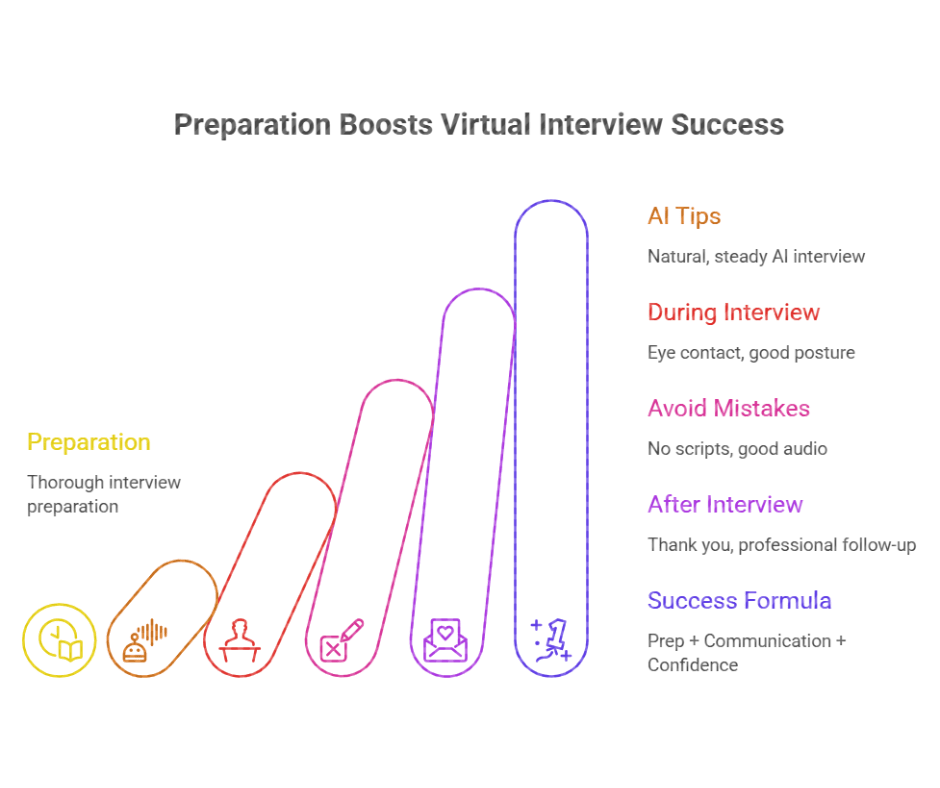
Virtual interviews reward preparation you can't fake in the moment — your setup, your structure, your comfort talking to a lens instead of a face. None of it is complicated, but almost nobody does all of it well, which is exactly why it's worth the extra hour of practice. Walk in — or rather, log in — ready, and let the interview be about what you actually know, not about fighting your Wi-Fi or your nerves.