Group Discussion Rounds in 2026: How to Be the Candidate Everyone Remembers
Published on July 30, 2026
Blogs
How to Be the Candidate Everyone Remembers
Walk into any GD room, and you'll spot the same instinct in half the candidates: talk more, talk fast, talk over the pause. It's the most common misread of what this round is testing. Recruiters aren't scanning for the loudest voice in a circle of ten — they're watching for someone who can think on their feet, hold a point without steamrolling the person next to them, and add something the discussion didn't already have.
If you've cleared the aptitude round and made it to a GD, whether that's a campus drive or a corporate hiring process, you've already cleared the harder filter. Here's the part nobody tells freshers early enough: GD rounds knock out plenty of candidates who were perfectly capable on paper. The reason is rarely a knowledge gap. It's a communication one. This piece walks through what evaluators are really scoring, the habits that get people eliminated fast, and the small moves that make you the person the panel remembers walking out.
What Recruiters Are Really Scoring
A GD isn't a debate you win by out-arguing everyone else. Think of it as a short audition for how you'd behave on a real team. Evaluators tend to weigh a handful of things:
Clarity of thought comes first — can you form a point and say it without wandering off halfway through? Listening matters just as much: do you build on what the last person said, or wait for a gap to jump in with your own script?
Confidence without aggression is its own skill — plenty of candidates confuse volume for conviction. Team behaviour shows up in whether you pull quieter people into the conversation or let them sit out. And relevance trips up more people than you'd think, because half-memorized points get dropped in, whether or not they fit.
Most structured evaluation grids put the heaviest weight on communication and content, with leadership, teamwork, and body language filling out the rest.
That should change how you prep — it's not about cramming more facts, it's about practicing how you say the ones you already have, under a clock, with nine other people trying to get a word in too.
Before the Discussion: The Prep That Pays Off
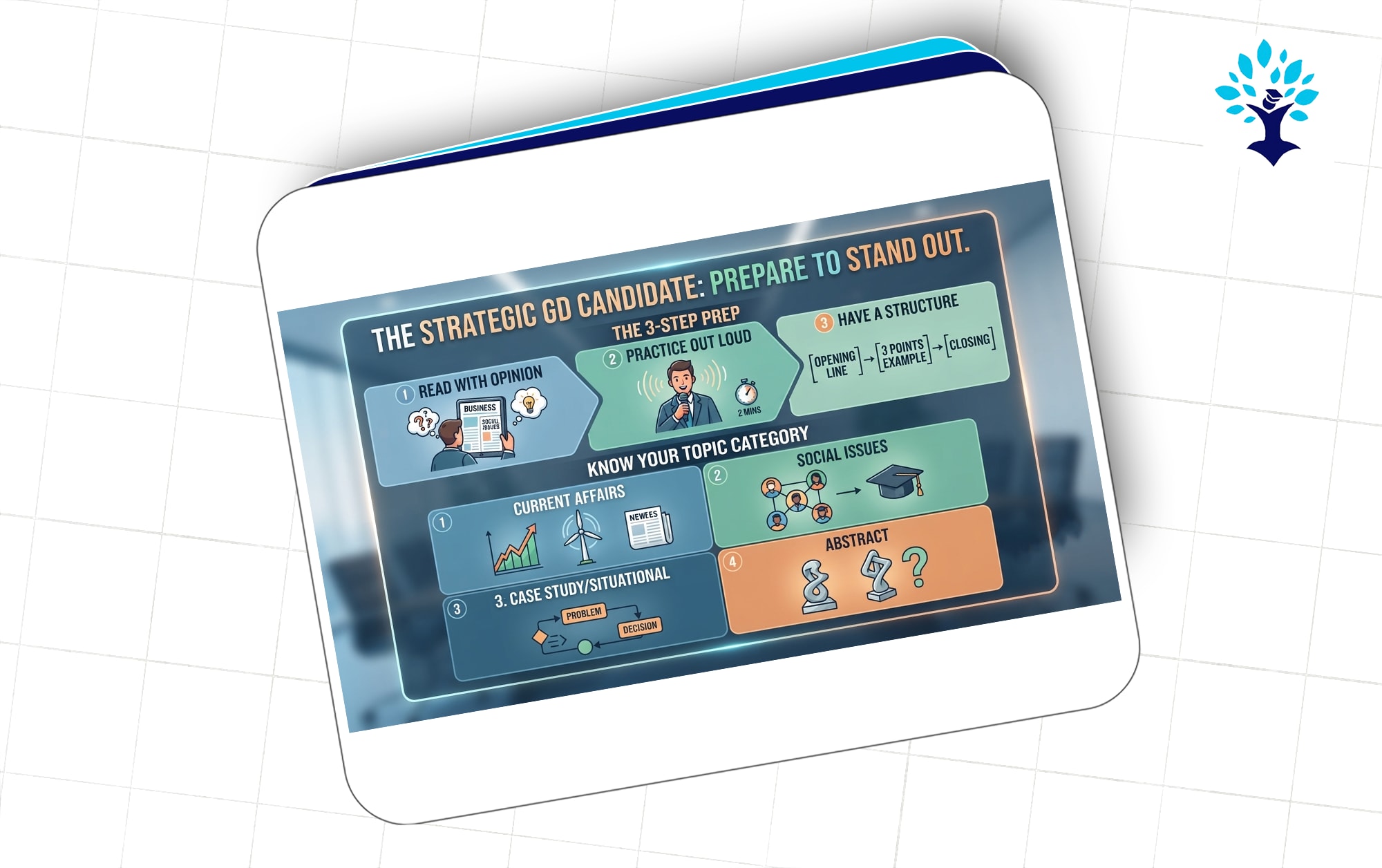
Read the news like you have an opinion on it, not just a summary. A few weeks of following business and social issues in something like The Hindu or Economic Times gives you real material — not the vague, half-formed opinions most candidates walk in with.
Speak the argument out loud before the day of the GD. Plenty of people read constantly and still freeze the moment they have to build a spoken point in real time. Two minutes on a random topic, argue one side, flip and argue the other, record it, and play it back.
Have a structure you can drop any topic into — a short framing line, two or three points with an example, a closing line that ties it together. Works whether the topic is AI replacing jobs or something abstract like "silence is golden."
Don't skip abstract topics in your prep just because they feel harder to pin down. They trip up more candidates than current-affairs topics, precisely because there's no obvious side to take.
Keep two or three sharp opening lines ready. You don't have to start every discussion, but if you do open, make it go somewhere — not a textbook definition nobody needed.
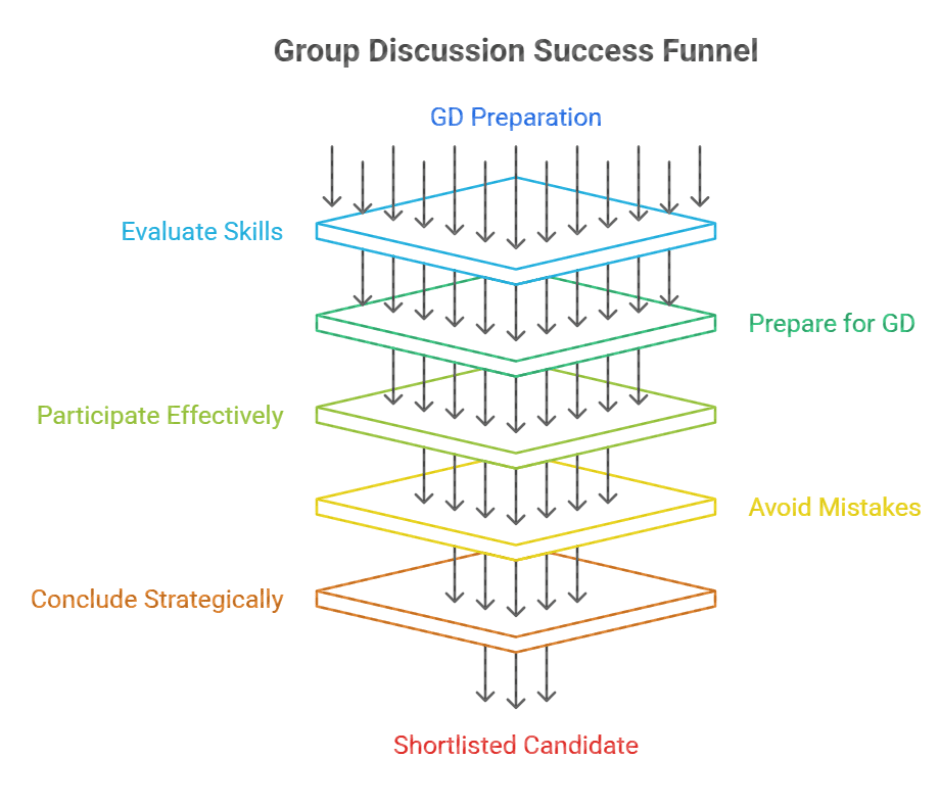
During the Discussion: What Separates a Good Candidate from a Forgettable One
Three or four meaningful contributions beat constant talking almost every time — quality wins over volume here, and evaluators notice the difference immediately.
Reference what someone else said before adding your own point. Even a short "building on what X just said" signals you were paying attention, which is exactly what evaluators are trying to catch.
If you notice a quieter group member isn't getting a word in, pull them into it. This one move reads as leadership far more clearly than anything you could say to prove it.
When the discussion drifts, redirect it. Pointing out — politely — that the group has wandered off-topic and steering it back shows presence of mind, and it's a lot harder to fake than a rehearsed opinion.
Push back on the point, never the person. You can disagree firmly and still stay respectful; aggressive pushback costs you points, no matter how right you turn out to be.
Body language counts even when you're not talking. Nodding, holding eye contact with whoever has the floor, sitting like you're in the conversation rather than waiting your turn, out — none of that goes unnoticed.
The Mistakes That Get Candidates Eliminated Fast
Cutting people off repeatedly, even when your point adds something worthwhile
Not letting the discussion breathe — talking non-stop and leaving no room for anyone else
Leaning on vague, generic lines with no example or data behind them
Sitting silent for most of the round and jumping in once, right at the end, hoping it counts
Getting visibly rattled or raising your voice the moment someone disagrees
Repeating a point that's already been made, just to look active
Any one of these can undo good preparation on its own. Evaluators pick up on patterns fast in a ten-to-twenty-minute window, so staying consistent matters more than landing one great line.
Know the Kind of Topic You're Walking Into
Not every GD topic wants the same approach, and spotting the category early lets you frame your opening faster than the rest of the room.
Current affairs and business topics — AI replacing jobs, remote work versus office work, data privacy, India's cashless economy — reward candidates who've followed the news closely, not just skimmed headlines. Social issue topics, like mental health at work or education reform, need balance more than a strong stance; evaluators want to see you weigh more than one side before landing somewhere. Case-study or situational topics hand the group a scenario and ask for a decision — test practical reasoning over opinion here, and stay focused on solving the problem rather than debating it. Then there are abstract topics: phrases like "boundaries create freedom" with no obvious side at all. Most candidates freeze because there's nothing factual to grab. The move is to interpret the phrase clearly in your opening line and build your argument around that.
Spot which bucket a topic falls into within the first ten seconds, and you'll be structuring your response while half the room is still figuring out what to say.
The Closing Move Most Candidates Skip
Near the end of most GDs, points start repeating, and the energy in the room flattens out. That's exactly where a sharp candidate can stand out — by pulling together the key arguments the group made and offering a short, balanced close. You don't need to have spoken the most to pull this off. You just need to have listened closely enough to tie it together. Evaluators rate this move highly, and for good reason: it shows the one thing they're screening for — the ability to synthesize a conversation, not just add noise to it.
Final Thought
A GD round rewards the kind of prep that's hard to fake in the moment — reading with intent, practicing out loud, listening instead of waiting for your turn to talk. And if the GD is only one step in the hiring process, don't stop preparing there — your next round could be a virtual interview, where communication, body language, and how you present yourself on camera matter just as much. The candidate who gets shortlisted is rarely the one who knows the most about the topic. It's usually the one who made the room easier to work with, then said something near the end that moved things forward. Walk in with that in mind, and the rest of it tends to sort itself out.