High Paying Jobs in Cybersecurity: How to Actually Get Started (2026 Guide)
Published on August 07, 2026
Blogs
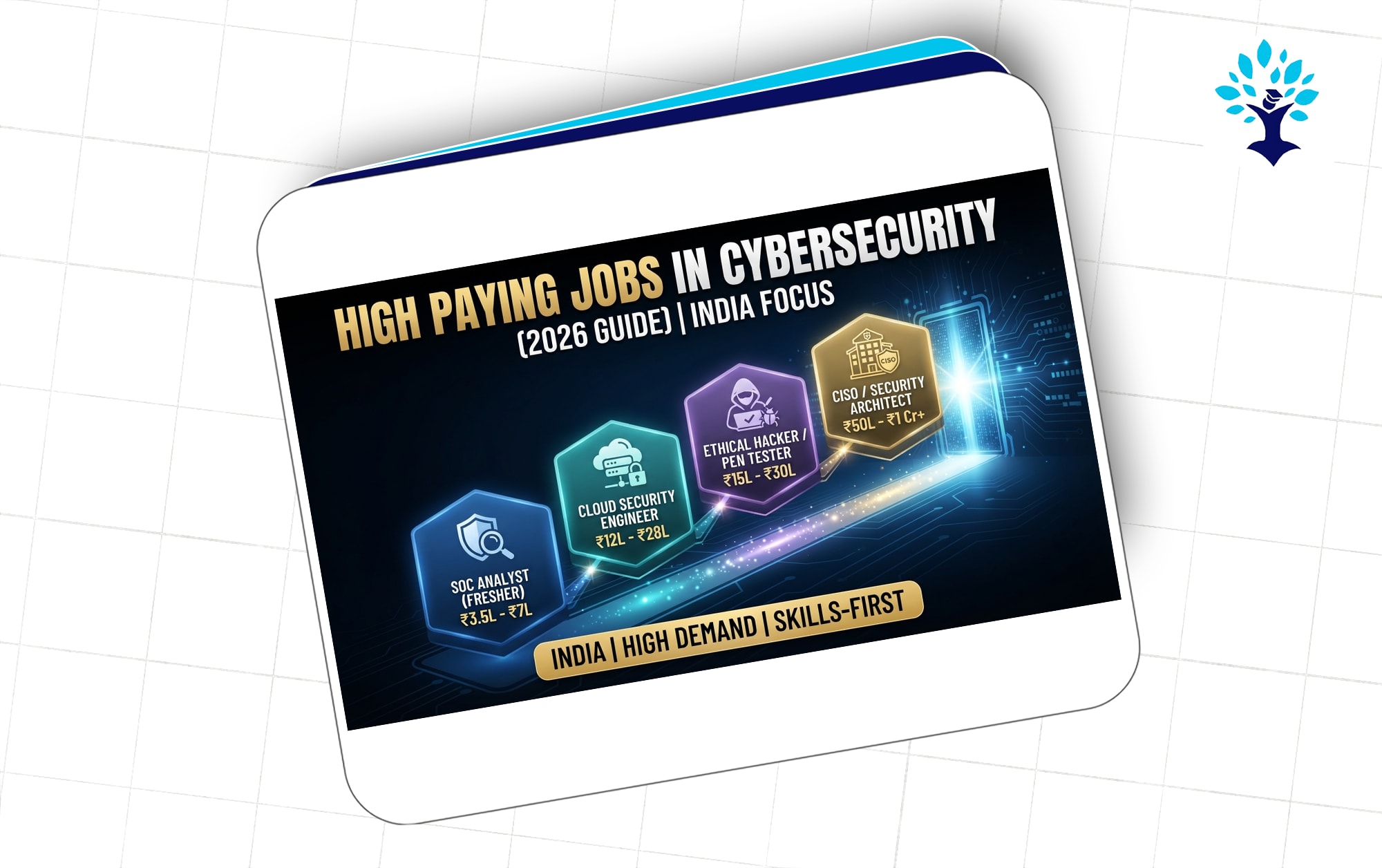
High-Paying Jobs in Cybersecurity
Somebody in your family has probably said this to you at some point — "There's a lot of scope in cybersecurity, you should get into hacking or something." And okay, they're not wrong, but they're also being pretty vague about it, right? Nobody actually tells you which job, what it pays, or how someone with literally zero experience gets from "I find this interesting" to "I'm actually employed in cybersecurity." That's the gap this article is here to fill. No hoodie-hacker stereotypes, no dramatic movie-style hacking scenes — just real roles, real salary numbers, and an honest step-by-step on how to actually get in during 2026.
Is Cybersecurity Actually Worth Getting Into Right Now?
Short answer — yeah, pretty clearly, and the numbers back it up.
India's expected to need over a million cybersecurity professionals, and a lot of companies are openly admitting they just can't find enough skilled people to fill their security teams. That gap isn't closing anytime soon either, which is exactly why pay in this field has stayed strong even while hiring has cooled off in other corners of tech.
Demand is outrunning supply, and not by a small margin. Only a small sliver of companies worldwide say they've actually got enough cybersecurity talent in place — most are stretched thin, and that shows up directly in what they're willing to offer.
Job openings jumped sharply just over the last year, with Bengaluru, Hyderabad, and Pune now soaking up the bulk of that hiring.
It's genuinely a skills-first field. Employers increasingly care more about hands-on labs, GitHub projects, and real certifications than which college name is on your degree.
It's not a niche IT corner anymore. Banking, healthcare, e-commerce, telecom, even government departments — everyone's hiring for this now.
The Career Ladder: What You Actually Earn at Each Stage
Nobody walks in on day one and lands a ₹40 lakh security architect job — that's just not how this works, no matter what some course ad implies. Here's what the real climb looks like.
Entry level (fresher, 0-2 years). Most people start out as an SOC (Security Operations Centre) Analyst or Junior Penetration Tester — monitoring alerts, digging into suspicious activity, and learning the basics of incident response. Pay usually lands around ₹3.5 to ₹7 lakh a year, though freshers holding a CEH or CompTIA Security+ certification often start closer to ₹6-8 lakh, especially at MNCs in the bigger cities.
Mid-level (3-6 years). This is where actually specializing starts paying off in a real way. Cloud Security Engineers, Application Security Engineers, and Threat Intelligence Analysts typically pull ₹12 to ₹28 lakh a year, and just moving from an L1 to an L2 analyst role can bring a 40-80% jump on its own.
Senior level (8-15 years). Security Architects and Cybersecurity Managers step into real money at this stage — often ₹20 to ₹40 lakh a year, sometimes more depending on company size and which industry you're in.
Leadership level (15+ years). A CISO (Chief Information Security Officer) sits right at the top of this ladder, and the pay reflects it — often ₹60 lakh to over ₹1 crore a year at bigger companies, especially now that regulations like the DPDP Act have made this role practically non-negotiable for a lot of businesses.
The Highest Paying Specializations Right Now
Not every cybersecurity job pays the same, and honestly, picking the right lane early changes your whole earning curve. Here's where the real money's sitting in 2026:
Cloud Security — as companies keep shifting infrastructure onto AWS, Azure, and Google Cloud, people who can actually secure those environments are in short supply, and something like AWS Security Specialty or Azure's AZ-500 genuinely adds a premium to your pay.
Penetration Testing / Ethical Hacking — one of the most merit-based tracks in this entire field, where a solid OSCP or CEH tends to matter more in an interview room than a traditional degree ever will.
Application Security — securing the actual software companies build and ship, and it's only gotten more important as businesses run more and more of their operations through their own apps and platforms.
Governance, Risk, and Compliance (GRC) — sounds a lot less exciting than "ethical hacker," sure, but it's genuinely well-paid, especially in banking and healthcare, where compliance failures carry real financial consequences.
DevSecOps — baking security directly into the development pipeline instead of bolting it on at the very end, and it's growing fast right alongside the broader DevOps hiring boom. Beyond cybersecurity, engineering roles in AI, cloud, data, and semiconductors are also seeing strong salary growth — explore our guide to Engineering Careers That Are Actually Paying.
How to Actually Get Started (Step by Step)
Step 1: Get the boring fundamentals down first. Networking basics, how operating systems work, how the internet actually functions under the hood — sounds dull, sure, but skipping this step is exactly why a lot of people plateau early and can't figure out why.
Step 2: Pick one beginner-friendly certification, and actually finish it. CompTIA Security+ or CEH are common, respected starting points, and either one genuinely helps you cross that ₹6 lakh mark even straight out as a fresher.
Step 3: Get your hands dirty in actual labs, not just tutorial videos. Platforms with hands-on labs, capture-the-flag challenges, and simulated attack environments matter way more than passively watching someone else do it on YouTube.
Step 4: Build a small portfolio you can genuinely show someone. A documented lab project, a bug bounty writeup, or a GitHub repo with real work does more for your credibility in an interview than a long list of course completion certificates ever will.
Step 5: Apply for entry-level SOC or junior analyst roles first, even if the starting pay isn't exciting yet. Most careers in this field genuinely start right here, and the jump to L2 within 18-24 months brings a real, sharp raise with it.
Step 6: Specialize once you've found your footing. After a year or two in a general role, pick one lane — cloud security, pen testing, GRC, whatever genuinely pulls at your interest — and go deep instead of staying a jack-of-all-trades forever.
A Few Mistakes Worth Avoiding
Collecting certificates while never actually touching a lab. A stack of certifications with zero hands-on practice behind them falls apart pretty fast once a real technical interview starts.
Ignoring the "boring" specializations. GRC and compliance roles don't sound as thrilling as ethical hacking, but they pay well and stay in constant demand, especially in regulated industries that genuinely can't afford to get this wrong.
Assuming a degree is mandatory. It genuinely isn't, for most entry-level roles and a good chunk of mid-level ones too — employers care a lot more about what you can actually show them.
Staying a generalist for way too long. Even a modest amount of specialization tends to unlock noticeably faster salary growth than trying to know a little bit of everything forever and never committing to a lane.
Final Word
Cybersecurity in 2026 isn't just some vague "there's a lot of scope in this" line your relatives throw around at dinner — it's genuinely one of the best-paying, most skill-first fields in tech right now, with a real, well-mapped path from fresher all the way up to leadership-level pay. The starting point isn't glamorous, and nobody's handing out overnight riches here, but the ladder is real, and it moves fast once you actually pick a specialization and commit to it. Nail the fundamentals, get one solid certification done, build something you can genuinely show, and land that first SOC or analyst role — everything else in this career tends to build from there.