15 Highest Paying Jobs in the World in 2026 (And What It Really Takes to Get There)
Published on August 01, 2026
Blogs
15 Highest Paying Jobs in the World in 2026
Ask ten people what the highest-paying job in the world is, and you'll get ten different answers. Doctor. CEO. Pilot. Investment banker. Somebody's cousin who "does something in tech." Here's the thing, though: there isn't one clean answer. The real picture is a mix of healthcare, executive leadership, and a handful of specialist tech and finance roles, all of them paying out for the same underlying thing: years of hard, narrow training that most people won't put in.
This list pulls together the roles that keep showing up at the top of global salary data in 2026, leaning on US and international benchmarks because that's still the yardstick most salary surveys reach for. If you're in India and eyeing one of these paths, most translate into strong domestic packages too, once you convert the currency and adjust for the cost of living. The absolute numbers shift. The direction they're pointing doesn't.
The List
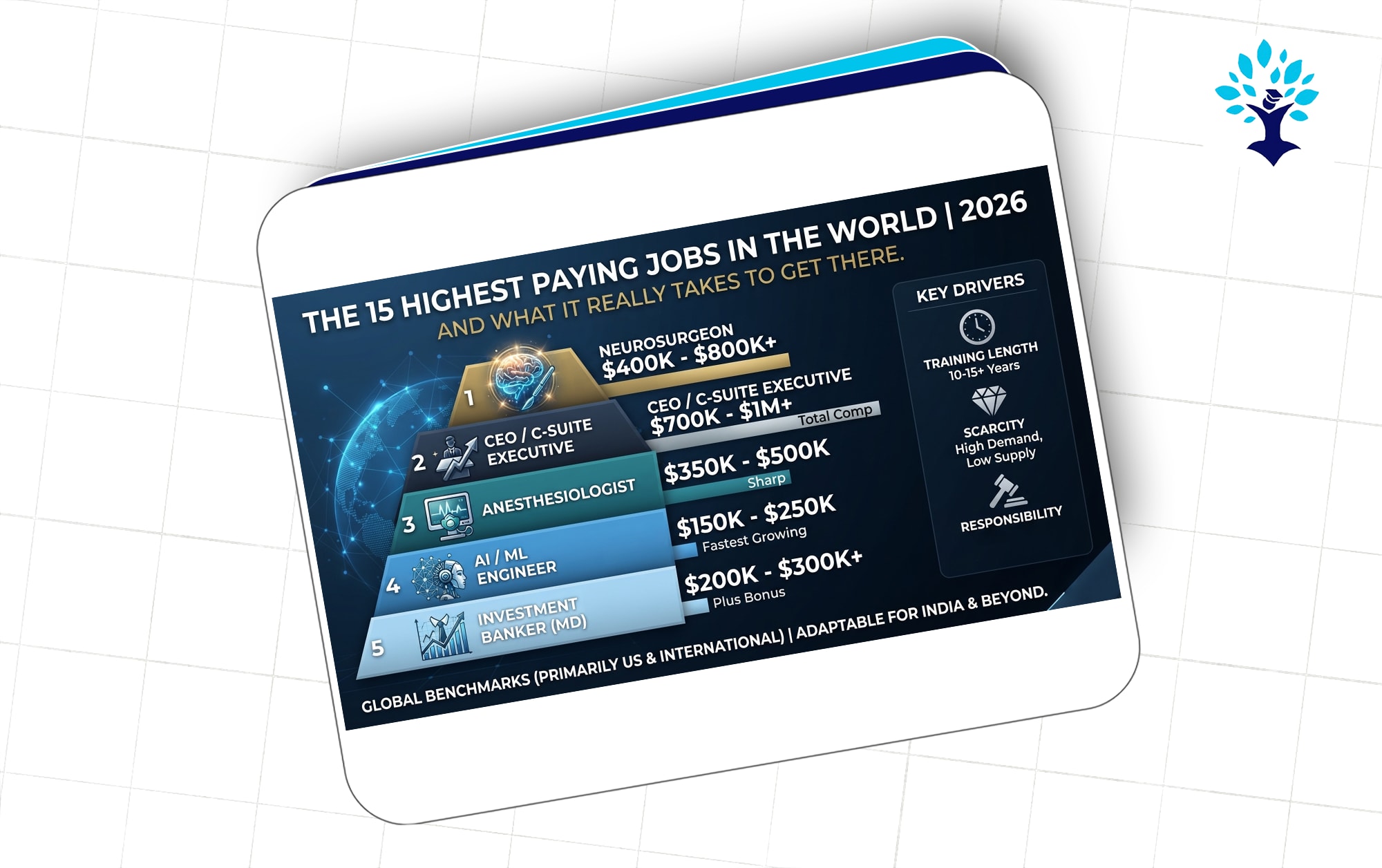
Neurosurgery sits at the very top almost every single year, and has for a while now. US averages run $400,000 to $800,000 annually, with senior specialists crossing $1 million. Getting there takes fifteen years or more between medical school, residency, and fellowship, and there's no version of this path that's shorter.
Right below that, CEO and other C-suite roles. Base pay alone often lands between $700,000 and $1 million, but total compensation through equity, bonuses, and long-term incentive plans pushes well past that at large corporations. Some go far past it once stock grants get factored in.
An anesthesiologist. averages $350,000 to $500,000 in the US, driven by the sheer weight of the responsibility and a training pipeline that never really shortens.
Orthodontist / oral and maxillofacial surgeon. typically $250,000 to $400,000, built on specialized surgical skill and a small pool of qualified practitioners worldwide.
Psychiatrist. Rising fast, now averaging $250,000 to $350,000, as mental health demand keeps growing and the specialist supply hasn't caught up yet.
Cardiologist. ranges from $350,000 up to nearly $600,000 for high-volume specialists managing complex procedures.
Investment banker (senior / MD level). base salaries of $200,000 to $300,000, with bonuses that can double or triple total pay in a good year.
Corporate lawyer (partner level). typically $200,000 to $400,000 at major firms, higher at top-tier international practices.
AI / ML engineer. the fastest-moving entry on this whole list. Averages $150,000 to $250,000, and these engineers now out-earn traditional software engineers by 30 to 40 percent, thanks to a talent shortage that isn't closing anytime soon.
Data scientist. generally $120,000 to $200,000, climbing well past that at senior levels as companies lean harder into data every year.
Petroleum engineer. $150,000 to $200,000-plus, especially strong across the Middle East, where tax-free pay and housing allowances stack on top of an already solid base.
Chief Technology Officer. $250,000 to $400,000, sitting at the center of every technology call a company makes.
Airline pilot (senior captain). $200,000 to $300,000 for long-haul captains, earned only after years spent logging hours as a first officer.
Actuary (senior level). $150,000 to $200,000, a quieter field than most here, built almost entirely on statistical and risk expertise.
Chartered accountant (senior / partner track). varies a lot by country and firm, but partners at large firms cross well into six figures internationally, with strong packages in India too for those who reach the top.
Why These Roles Pay What They Do
Three things separate this list from the rest of the job market, and they're the same three things every time you dig into it. Training length is one. Most healthcare roles here demand ten to fifteen years between education and full qualification, and there's no shortcutting that clock, no matter how good you are. Scarcity is another. AI engineers, data scientists, and specialist surgeons are all in short supply relative to demand, and pay moves fast whenever supply can't keep up. Responsibility rounds it out. CEOs, surgeons, and pilots all carry outcomes that directly affect other people's lives or a company's survival. Pay tends to track that weight pretty closely.

How This Looks From India
Global salary surveys are almost always benchmarked in USD, which makes this whole list feel disconnected from what these careers pay closer to home. Fair point. But it's not the whole story. Senior neurosurgeons, cardiologists, and psychiatrists in India's top private hospitals routinely earn ₹40 lakh to over ₹1 crore a year, and that gap narrows further once a doctor builds a strong private practice. Corporate law follows a similar arc. Partners at leading Indian firms, or international practices with a real India presence, cross ₹1 crore once they've built a solid client book of their own.
Tech is where the story moves fastest. AI and ML engineers at Indian offices of global companies, or at well-funded domestic startups, are pulling in packages that would've felt unthinkable five years back, often ₹25 to ₹60 lakh for experienced engineers, with senior and lead roles going well past that. Data science, CTO-track roles, senior chartered accountancy at Big Four firms or large corporates, all following the same arc. The dollar figures on this list belong to the US or the Middle East. The direction they point in, tech and specialized healthcare pulling further ahead of nearly everything else, holds just as true here.
What This Means If You're Planning a Move for Real
Healthcare and tech dominate this list because both reward deep, hard-to-copy expertise over broad, general experience.
A long training timeline isn't really the downside people assume. A neurosurgeon's fifteen years look completely different at 22 than it does at 35, even though the number on paper stays the same.
AI and data roles offer the shortest realistic path to strong pay among the technical fields here, especially next to medicine or law, where the timeline barely moves, no matter your talent.
Location matters more than people expect. The same role can pay two to five times more in the US, Switzerland, or the Middle East than it does in most other parts of the world.
Specialization beats general skill, consistently, across every field on this list. The top earners were never the generalists. They're the ones who went deep into one narrow, high-demand corner of their field and stayed there long enough to matter.
High-paying careers also require you to communicate your experience clearly once you start applying for them. Learning the Star Method can help you structure your achievements and answer experience-based interview questions with more impact.
Final Thought
None of these fifteen jobs are shortcuts, and nobody stumbles into one by accident. Every entry here demands years of focused effort, and most come with pressure that never shows up on a salary chart. But if you're mapping out a long game instead of chasing a quick jump, this is a fair, honest read on where the world is currently willing to pay the most for skill, scarcity, and responsibility, all stacked on top of each other. Pick a direction early, put in the years it takes, and this list stops looking abstract. It starts looking like a real, reachable target, one you could be standing on in a decade if you start now.