Top 20 Interview Questions in 2026 — And How to Actually Answer Them Without Sounding Rehearsed
Published on July 22, 2026
Blogs
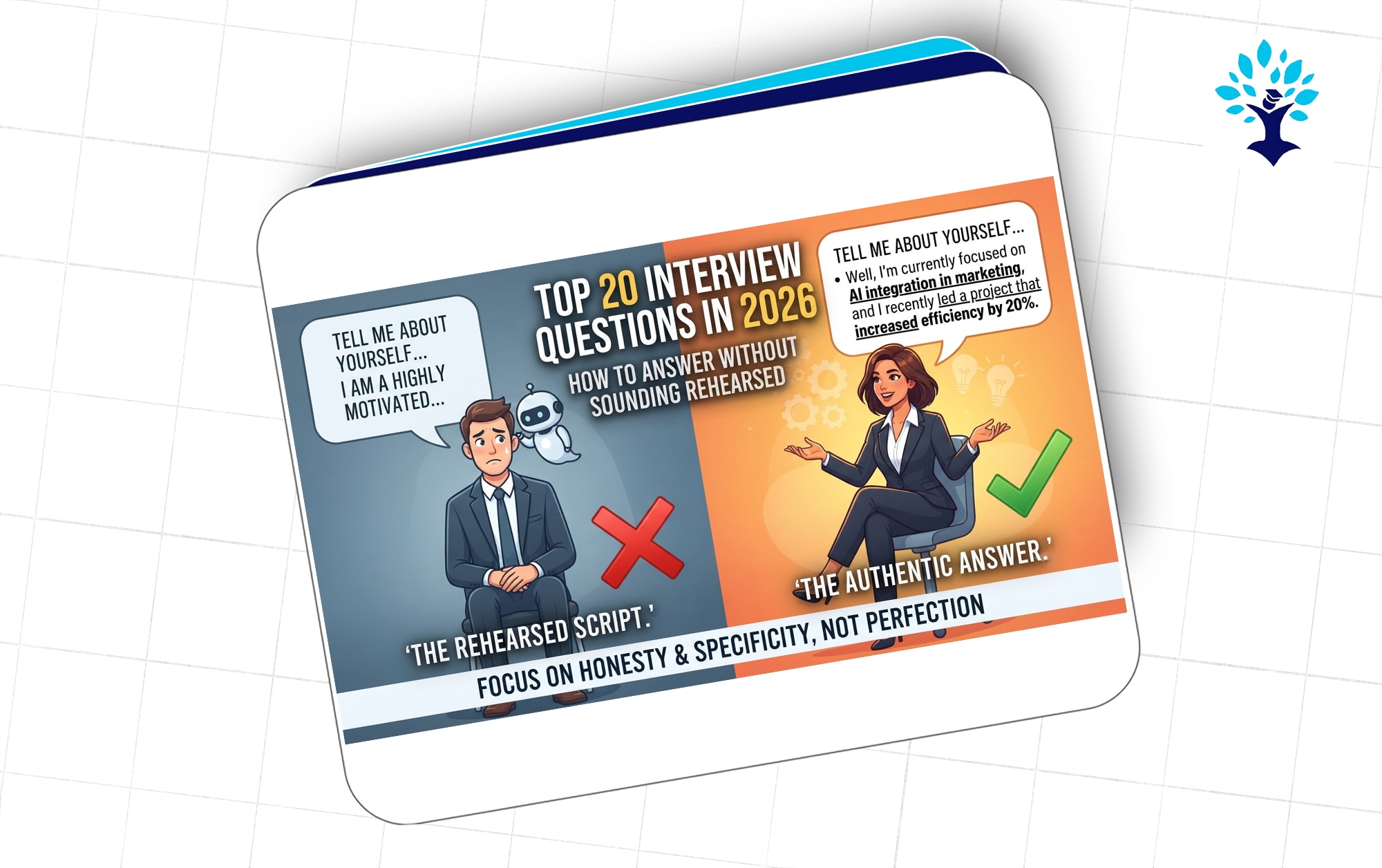
And How to Actually Answer Them Without Sounding Rehearsed
Okay, real talk for a second. You're sitting in that waiting area, knee bouncing, going over your answers in your head one last time — and then the interviewer leans back, smiles, and says, "So, tell me about yourself." And somehow, even though you knew it was coming, your brain just... blanks. Goes completely white for a second.
It happens to everyone. Genuinely. I've watched confident, sharp people fumble that exact opener more times than I can count, and it's rarely because they're unqualified. It's because they prepared the wrong thing. They memorized answers word for word instead of actually understanding what the question is digging for underneath.
Here's the part that's kind of funny once you notice it: these twenty questions haven't really changed in years. Same greatest-strength question your older sibling probably got asked in 2010. What's actually shifted is how interviewers are listening now. With so many people leaning on AI to smooth out every sentence before they even open their mouth, interviewers have gotten oddly good at sniffing out an answer that sounds rehearsed versus one that sounds, well, like a person actually said it. So this isn't just twenty questions and twenty tidy answers. It's more like — here's what's actually being tested, so stop memorizing and start understanding.
The classics everyone somehow still botches
"Tell me about yourself." Please don't start with your childhood. I beg you. Give a tight, thirty-second snapshot — where you are right now, one genuinely solid achievement, and why you're sitting in that chair today. Done. That's the whole thing.
"Why should we hire you?" This isn't your cue to read your resume back at them like a Wikipedia page. Pick one specific skill, connect it to one specific problem this role exists to solve, and stop there. Specificity does all the heavy lifting.
"Why do you want this job?" "It seemed like a great growth opportunity" is what someone says when they didn't actually look the company up. Mention something real instead — a product they shipped, a project you genuinely respect, a value that pulled you in specifically.
"Where do you see yourself in five years?" Show some ambition, sure, but don't sound like a flight risk either. Tie your own growth into where the company itself seems to be heading, not some unrelated dream you've mentioned nowhere else in the conversation.
"Why are you leaving your current job?" Stay forward-looking. Always. Even if your current job is genuinely a nightmare, "I'm looking for more ownership and a bigger challenge" beats any version of trashing your old boss, every single time.
Strengths, weaknesses, and the answers people fake the hardest
"What's your greatest strength?" One strength. One real story behind it. One clean line connecting it to this exact role. Not three vague traits read off a personality quiz you took once for fun.
"What's your greatest weakness?" Can we please, collectively, retire "I'm too much of a perfectionist"? It stopped fooling anyone around 2015. Name something actually true, then show what you're doing about it right now, today, not someday.
"What's your biggest achievement?" Numbers win this one. "Grew sales 40% in one quarter" beats "I worked really hard on a big project" without even trying, because one of those is provable and the other one's just a feeling you had.
"Tell me about a time you failed." Actually own the failure. Don't quietly spin it into a secret victory — interviewers can smell that from across the room. They care way more about what you learned than whatever went sideways in the first place.
Behavioral questions — where most people improvise badly under pressure
"Describe a conflict with a coworker." Lean on the STAR method — Situation, Task, Action, Result — and keep your focus on how calmly you resolved it, not on proving you were the right one.
"Tell me about a time you showed leadership." You don't need a fancy title for this one. Any moment you took initiative, and people actually followed where you went, counts as a legitimate answer.
"Describe a time you worked under pressure." Pick something real, something you actually lived through, not a hypothetical. Walk through what you did, and land on the outcome — good, ideally, but honest matters more than impressive.
"Tell me about a time you disagreed with your manager." Show respectful pushback. Not blind agreement, not stubbornness either. This question is testing your judgment, not how badly you needed to win.
"Describe a time you had to learn something quickly." Get specific about the actual gap you had and exactly how you closed it. This is your moment to prove adaptability, not just announce that you have it.
Company fit, and the questions that quietly test whether you even tried
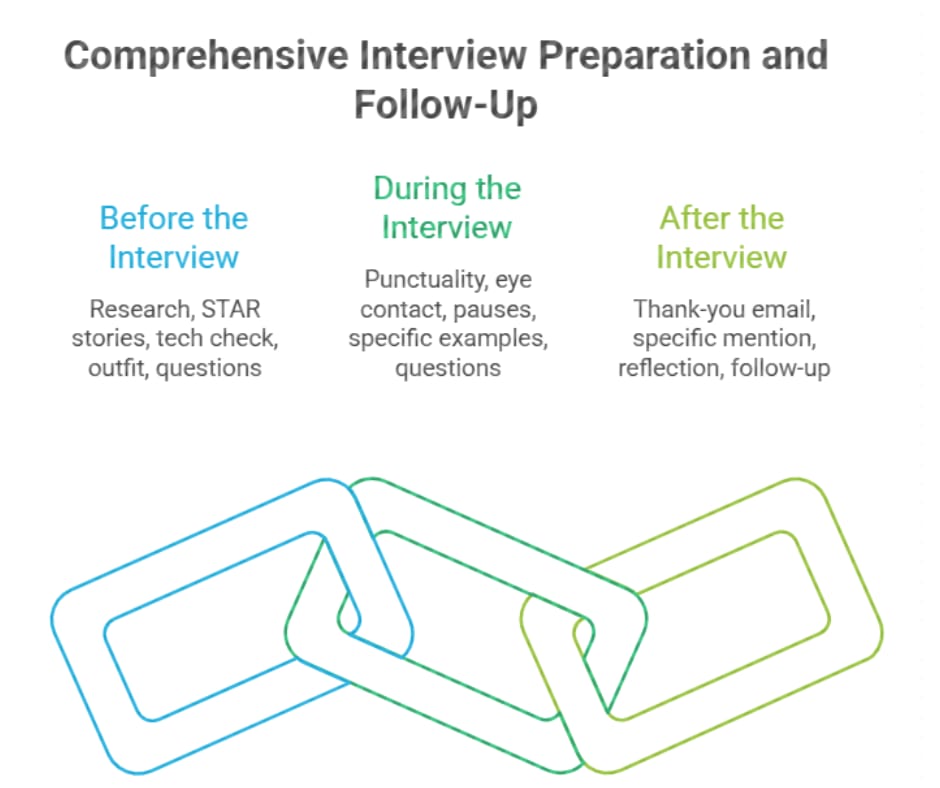
"What do you know about our company?" This one's purely a laziness check, honestly, and it's the easiest one to flunk. Fifteen minutes on their website beforehand is genuinely all it takes, and skipping it shows almost immediately.
"Why do you want to work here specifically?" Skip the flattery — nobody buys "your culture seems amazing." Mention something concrete instead, a product call, a market position, a stated value, something that actually connects to what you care about.
"What are your salary expectations?" Do your homework on the range first, then offer a range back, not one fixed number. And try not to commit before you really understand the full scope of what the role actually involves.
"Do you have any questions for us?" Say yes. Every time. A thoughtful question about team structure or current priorities signals real engagement — "nope, I think you covered it all" reads as disinterest, even when that's not remotely what you meant.
The newer ones that have crept in specifically because it's 2026 now
"How do you use AI tools in your work?" This has spread way beyond tech roles at this point — marketers, writers, analysts, almost everyone's getting some version of this now. Be honest about how AI helps you move faster, but make it clear you're still the one making the actual calls.
"How do you stay current with changes in your industry?" Things are moving fast right now in basically every field, and interviewers want some proof you're not coasting on outdated skills. Name something specific — an actual newsletter, a course, a community — instead of a vague "I just try to keep up with things."
The thing that matters more than any answer on this list
Here's what most "top questions" lists never quite say out loud: in 2026, interviewers are listening for honesty and specificity way more than polish. A slightly clumsy but real answer beats a smooth, clearly over-rehearsed one almost every time now, mostly because over-rehearsed has started sounding suspiciously like AI-generated, and people have gotten sharp at catching that. Even the best interview answers won't help if you never get the chance to sit across from a hiring manager. That's why many job seekers also focus on writing an effective Cold Email For Job opportunities to connect with recruiters before a position is even advertised. Practice your structure if it helps you feel steadier walking in. Just don't memorize your script word for word — let your own phrasing wobble a little each time you say it out loud. That wobble is what makes it sound like you.
Honestly, that's the whole trick hiding underneath all twenty of these. Nobody in that room is grading you on a flawless monologue. They're listening for whether the person across the table sounds like someone they'd actually want to sit next to on a hard Tuesday — not someone who just memorized the right things to get past today.