Top Careers in Artificial Intelligence and Machine Learning (2026 Salary Guide)
Published on August 08, 2026
Blogs
Top Careers in Artificial Intelligence and Machine Learning
Everyone's talking about AI right now, and honestly, most of it is noise — "AI will take your job," "learn AI in 30 days," that kind of thing. What barely anyone talks about clearly is which actual AI and ML jobs exist, what they pay, and what it genuinely takes to land one in 2026. So let's skip the hype cycle and just get into it — real roles, real salary ranges, and a straight answer on what recruiters are actually looking for right now.
Why AI and ML Careers Are Booming Right Now
This isn't some overnight trend that showed up out of nowhere. A few things pushed it here at once.
Every industry wants a piece of it now. Healthcare, finance, retail, manufacturing, even education — companies across sectors are hiring AI and ML talent, not just the usual IT giants. The number of AI-related job openings in India is expected to roughly double compared to just a couple of years ago.
Generative AI changed the hiring math completely. Companies now specifically want people who can work with large language models — deploying them, fine-tuning them, building real applications on top of them — and that's created a whole new set of well-paying job titles that barely existed a few years back.
India has become a genuine AI talent hub. Startups and multinational companies are actively competing for the same pool of skilled people, which naturally keeps pushing salaries upward.
It's not just for engineers anymore. Roles like AI Product Manager or AI Business Analyst let people with a business or ops background get in without needing to write a single line of model code, which has widened who can actually enter this field.
Alright, here's where the actual jobs and numbers come in.
Top Careers in AI and Machine Learning in 2026
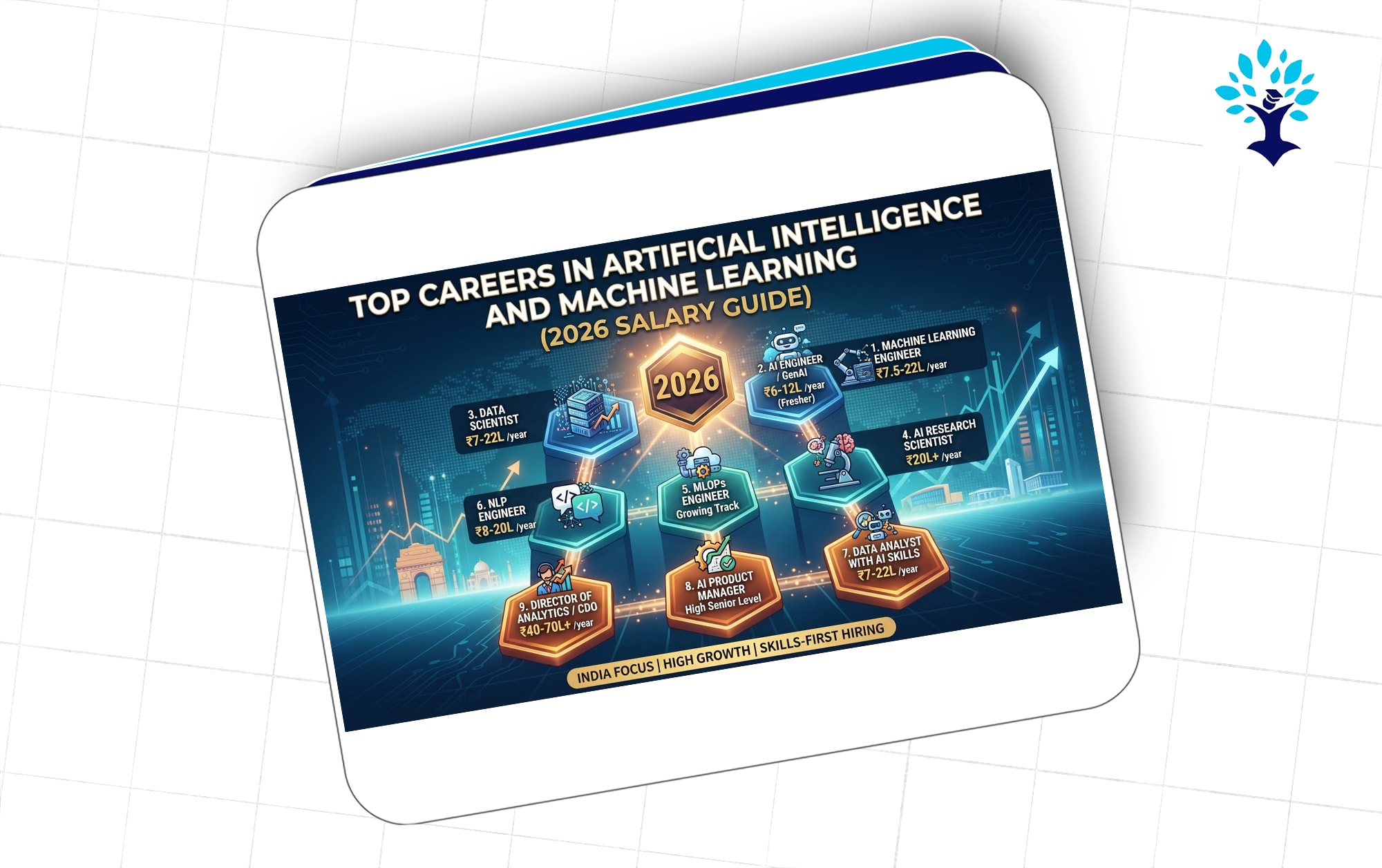
1. Machine Learning Engineer Probably the most well-known title in this space, and for good reason — it's the backbone role. You're designing, training, and deploying ML models for things like recommendation engines, forecasting tools, and automation systems, then making sure they actually hold up once they hit production. Pay typically ranges from ₹7.5 to ₹22 lakh a year, depending on experience, and senior ML engineers at product companies can go well beyond that.
2. AI Engineer / GenAI Engineer. This is arguably the hottest entry point into AI right now. GenAI engineers build real applications on top of large language models — chatbots, internal company assistants, document-processing tools, systems that let an AI answer questions using a company's own data. Because the field is so new, genuinely skilled people are still scarce, which is exactly why fresher salaries here are unusually strong — roughly ₹6 to ₹12 lakh a year straight out of the gate, sometimes touching ₹11-12 lakh with solid project work behind you.
3. Data Scientist. The role that's been around the longest in this space, and is still one of the most in-demand. Data scientists dig through large datasets to find patterns, build predictive models, and turn raw numbers into decisions companies can actually act on. Pay generally sits around ₹7 to ₹22 lakh a year, climbing sharply with experience and domain expertise — someone who deeply understands finance or healthcare data, for instance, tends to earn noticeably more than a pure generalist.
4. AI Research Scientist. The most academically demanding role on this list, usually reserved for people with a strong research background — often a master's or PhD, or serious published work in the field. Research scientists work on pushing the actual boundaries of what AI models can do, not just applying existing ones. It's a smaller, more competitive pool, but the pay reflects that — often ₹20 lakh a year and well beyond at top companies and deep-tech firms.
5. MLOps Engineer: The behind-the-scenes role that keeps everything running smoothly once a model leaves the lab. MLOps engineers build and maintain the pipelines that get models into production, monitor how they're performing, and make sure they keep working reliably in real cloud or on-prem environments. If you like the engineering side of AI more than the pure research side, this is a strong, steadily growing option, with clear next steps toward MLOps Lead or Cloud ML Architect roles later.
6. NLP Engineer A more specialized track focused specifically on language — building systems that understand, generate, or translate text and speech. With the explosion of chatbots and LLM-powered products, NLP skills have become genuinely valuable on their own, not just as a subset of general ML work. Pay tends to track closely with general ML engineer ranges, often landing in the ₹8 to ₹20 lakh a year zone depending on experience.
7. Data Analyst with AI Skills. The most realistic entry door for people who aren't hardcore coders but are genuinely good with data and business logic. You're not building the models from scratch, but you're working closely with AI-driven insights, dashboards, and decision-support tools. It's a great starting point that opens naturally into deeper AI and ML roles later, once you've built some real project experience.
8. AI Product Manager For people who understand both the tech and the business side, this role sits at a really valuable intersection — deciding what AI features actually get built, translating business needs into something engineering can act on, and making sure AI products actually solve a real problem instead of being a gimmick. It doesn't require heavy coding, and it tends to pay very well because good AI product judgment is genuinely rare — often crossing well into senior ML engineer salary territory once you've got real product launches behind you.
9. Director of Analytics / Chief Data Officer. The top of the ladder for most people in this field. These are leadership roles overseeing entire ML and analytics teams, setting AI-driven business strategy, and making sure data actually shapes company decisions instead of sitting in a dashboard nobody looks at. It takes years to get here, but the pay at this level is some of the highest in tech — often ₹40 to ₹70 lakh a year or more at bigger companies.
Skills That Genuinely Matter Right Now
Python is still the backbone skill, full stop. Almost every role on this list assumes solid Python fundamentals — there's no serious shortcut around this one.
Real projects beat certificates, every time. If you're still building those fundamentals, these free courses recruiters actually recognize can help you learn the basics without spending heavily on certifications. A candidate with two genuinely built and deployed projects consistently beats someone with five certificates and nothing actually shipped. Recruiters have caught onto this pattern fast.
Working with LLMs is quickly becoming a baseline expectation, not just a nice-to-have. Understanding how to use model APIs, build retrieval-based systems, and constrain model outputs sensibly is turning into a genuinely valuable, well-paid skill on its own.
Cloud comfort matters more than people expect. Deploying and scaling models on AWS, Azure, or GCP is a big part of actually getting AI into production, not just building it in a notebook.
Business understanding is an underrated multiplier. Being able to connect an AI solution back to an actual business outcome tends to boost your value — and your pay — noticeably more than pure technical skill alone.
A Realistic Path Into AI and ML
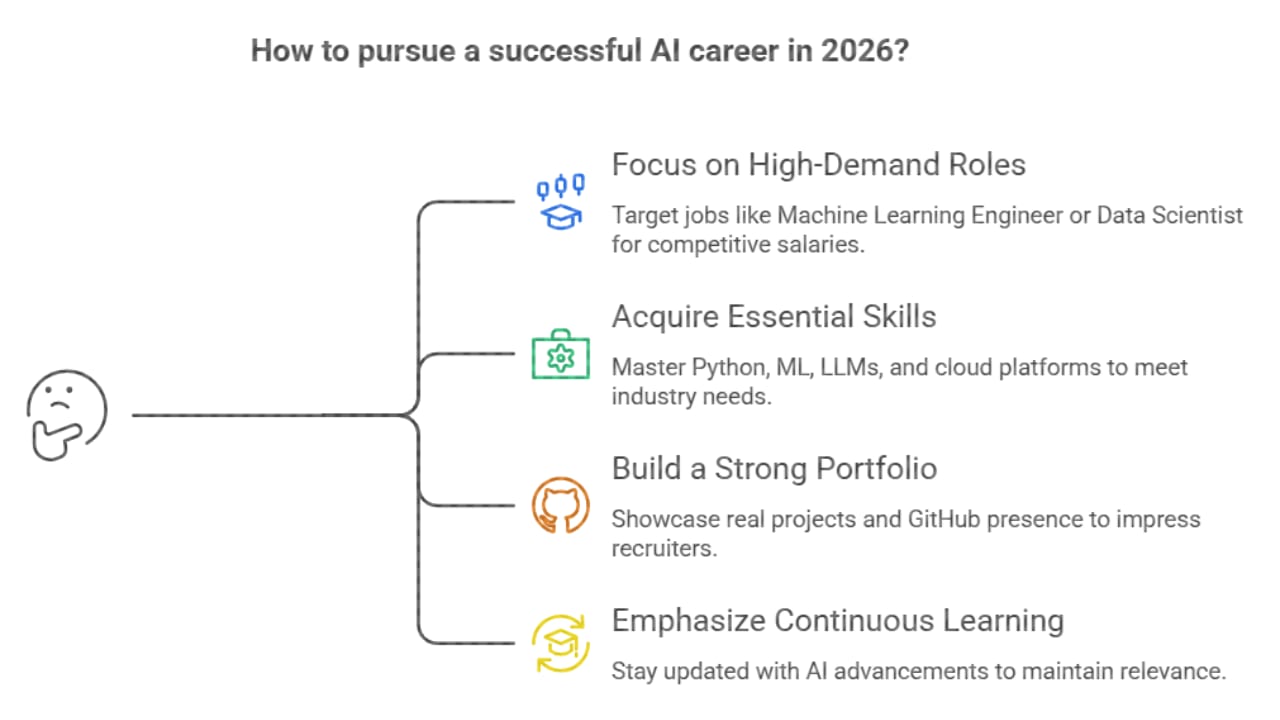
If you're a strong coder, aim straight at ML engineering or GenAI engineering, and get genuinely comfortable with the core Python libraries used in the field. If you're more comfortable with data and business logic than heavy coding, a Data Analyst with AI skills is the fastest realistic door in — and it naturally opens onto the more technical roles later, once you've built some experience. Either way, spend the first few months building strong fundamentals — Python, basic statistics, core ML concepts — and work on small, real projects using actual datasets rather than just watching tutorial after tutorial. The people who genuinely do well in this field are the ones who keep shipping and learning well past their first job, which is usually also when the sharpest salary jumps start showing up, often by around year three.
Final Word
AI and machine learning aren't some passing tech trend that'll cool off in a year or two — they've become one of the most durable, fastest-growing career paths available right now, and 2026 is genuinely a strong year to get in, whether you're just starting or switching careers entirely. The pay is real, the demand is real, and unlike a lot of traditional fields, this one rewards people who can actually build and operate working systems, degree or no degree. Pick the entry point that matches where you already stand — coding-heavy or data-and-business-focused — start building something real today, and let that work speak for you when it's time to apply.