What Makes Commerce the Smartest Career Move After 12th
Published on July 25, 2026
Blogs

Why Commerce is the Smartest Career Move After 12th
Let me address something that needs to be said directly.
Commerce is consistently one of the most undervalued stream choices in Indian schools — overshadowed by the prestige attached to Science and the sympathy extended to Arts. Students who choose Commerce are often made to feel like they "settled." That narrative is not just wrong. It is costing thousands of students the confidence they need to build extraordinary careers.
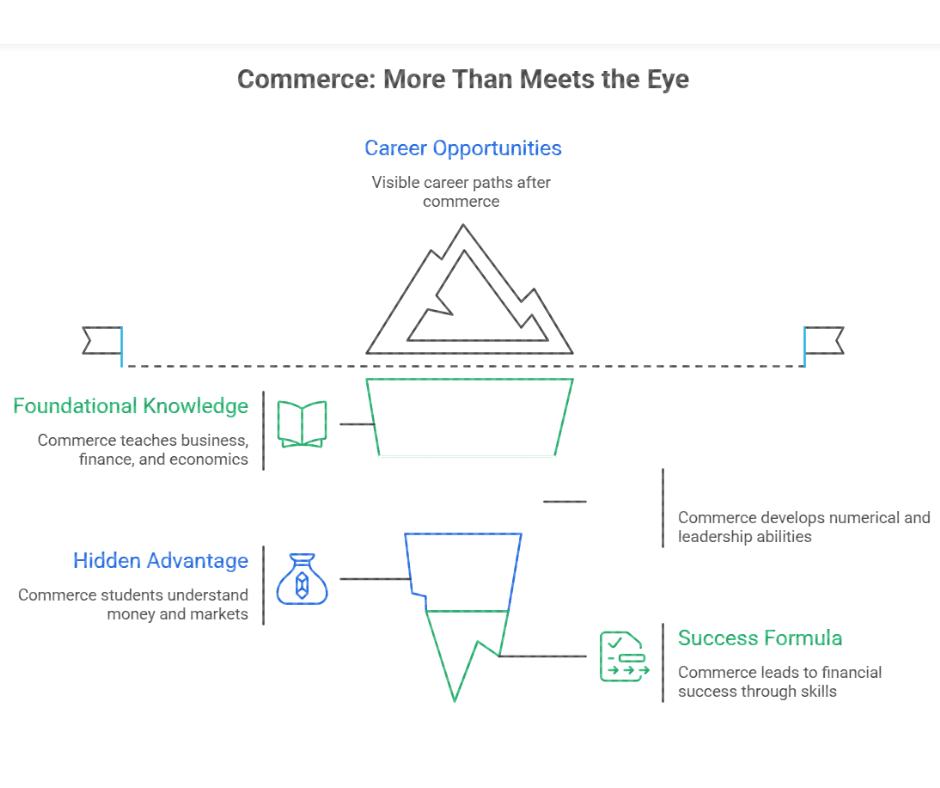
If you are a Commerce student — or are considering becoming one — understand this: you are entering a stream that trains you to understand how money moves, how businesses are built, and how financial systems that power entire economies actually function. That is not a small thing. That is the foundation of the professional world. Before making your final decision, it's also worth understanding Why Most Science Students Regreat their Career choice, especially if you're still comparing different streams after Class 12.
Who Is Commerce Really Built For?
Before we talk about options, let us talk about fit. Commerce is genuinely the right choice if you are drawn to numbers and financial logic, if you enjoy understanding how businesses operate, if you are interested in economics, markets, and systems thinking, or if leadership and management excite you more than laboratory research or creative arts.
If even two or three of those resonate, you are in the right place. Now let us talk about where Commerce can actually take you.
The Career Paths That Matter — Broken Down Honestly
CA — Chartered Accountancy: The Summit of Finance Careers
Let us start with the one that carries the most weight. A Chartered Accountant is not just an accountant. A CA is a financial authority — someone corporations trust with their most critical financial decisions, compliance obligations, and strategic planning.
The CA qualification is brutally competitive and demands long-term discipline. The dropout rate is high. But so is the reward for those who see it through. A qualified CA commands respect, authority, and earning potential that very few other Commerce-based qualifications can match. If you have the discipline and the long-term mindset, CA is worth every difficult year it takes.
BCom — Your Foundation, Not Your Ceiling
A Bachelor of Commerce is one of the most versatile degrees available. On its own, it opens doors in accounting, finance, taxation, banking, and human resources. Paired with professional certifications — CA, CMA, CS, CFA — it becomes a genuinely powerful credential.
The mistake many BCom students make is treating the degree as the destination. It is not. It is the foundation. Build on it deliberately.
BBA + MBA — The Management Fast Lane
In case you have the urge to lead, develop a corporate strategy, or embark on entrepreneurship, then you should go for BBA followed by MBA. A BBA helps you develop a solid ground in business basics: Marketing, Operations, HR, and Finance. An MBA, particularly from a well-recognized school, will help your career get a head start on getting to senior management, consulting, or into your own business.
This mix is especially beneficial for students who have an early awareness that they prefer to contribute to and lead organisations rather than specialise in a technical role.
Teaching — B.Ed / D.Ed: Stable, Respected, and Growing
For the students who are truly passionate about the process of explaining, mentoring, and molding young minds. Commerce educators — especially those who can make Economics, Accountancy, and Business Studies genuinely interesting — are in consistent demand. B.Ed and D.Ed are structured qualifications that lead to stable, dignified careers with defined growth.
The Hidden Advantage Commerce Gives You
Here is something I tell every Commerce student I counsel: you are learning the language of the professional world before most of your peers even know it exists.
Science students spend years learning how things work. Arts students learn how people think. Commerce students are taught about how the world works: how capital moves around, how an organisation is organised, and how decisions with financial implications are taken. That knowledge builds up over time and is more than multiplicative.
A Commerce graduate who has acquired financial skills with practical experience will always outperform and out-earn students who have opted for Commerce without possessing financial skills.
Final Thoughts: What you must do right now
Don't wait until things feel glamorous to start shopping at Commerce. Not showy, but strong! And great things await those who make real progress and do not be distracted by the glitter of superficial glory.
Choose your pathway in Commerce. Be familiar with the requirements. And begin now to build!
It is important to note that the winners of this stream are not the most talented students at age 17. It is they who were most disciplined at 20, 22, and 25.